Guide
Free alternative to PocketGuard: Lipi for manual tracking without the subscription
Lipi is the free alternative to PocketGuard: manual tracking with no bank link, budgets and splits free, and no subscription to see your own money. Premium costs USD 3 a month, or USD 2 a month billed yearly (USD 24).
By Bikram LamaPublished Updated 18 min read1 view
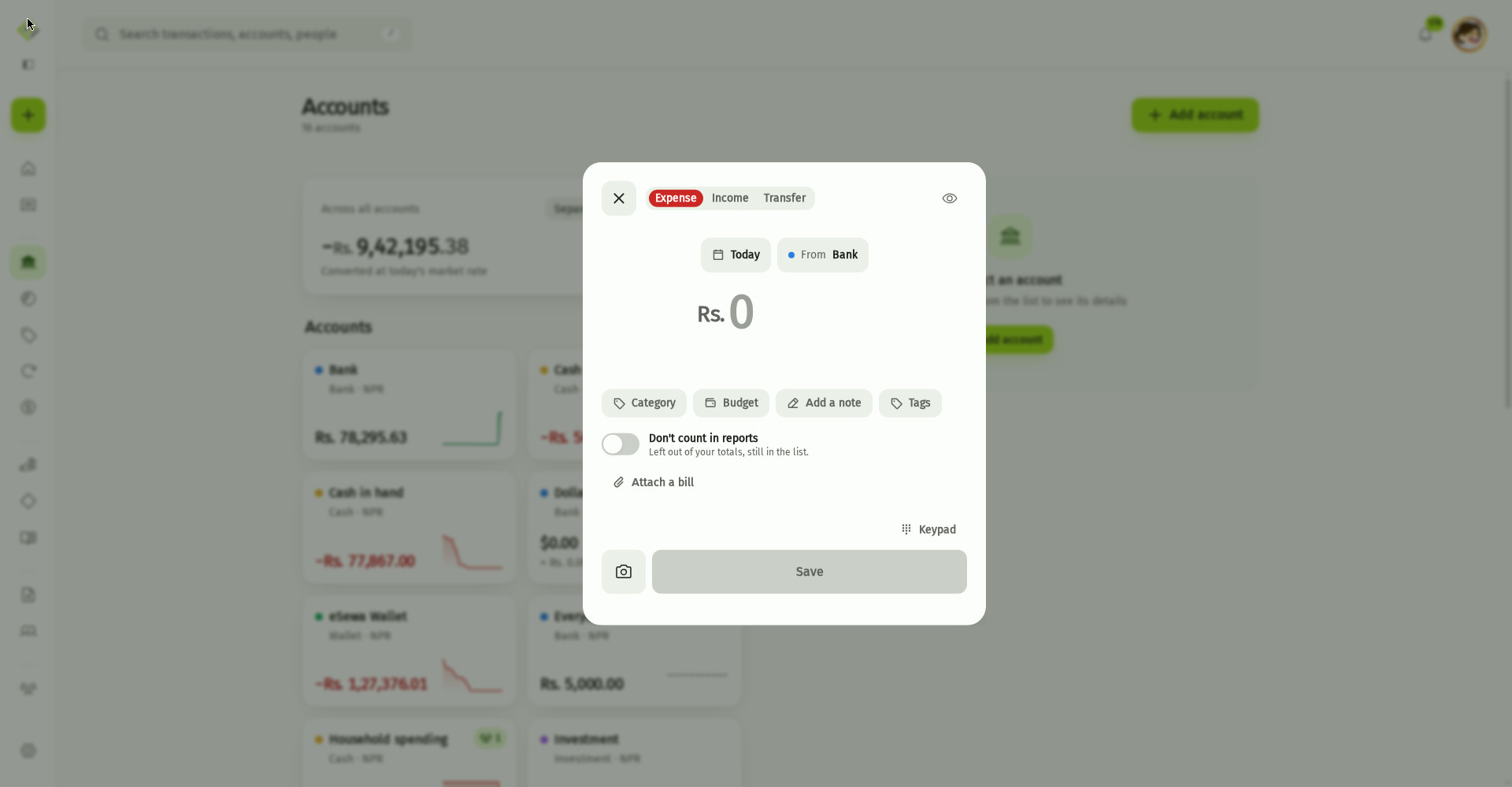
Lipi is the free alternative to PocketGuard: no bank link, no subscription, budgets and splits free.
PocketGuard is built around one idea. Link your accounts, and it works out Leftover, the money left to spend once bills, goals and budgets are covered. That number is genuinely useful, and it is the reason many people pick PocketGuard first. The trouble starts after setup. The bank link drops, the trial turns into a yearly charge, and the app that was meant to save you money starts costing $74.99 a year to open. Lipi answers the same question with manual entry instead of a bank link: you log spending as it happens, budgets show what is left, and the whole thing is free to start with no subscription in the way.
Open Lipi and set up your PocketGuard replacement today. Tracking, budgets and splits are free, and the setup takes an evening.
Why people leave PocketGuard
The low-star reviews of PocketGuard repeat the same three complaints, and a study of the recent ones puts numbers on them. CashJot coded 200 of PocketGuard's one- and two-star App Store reviews, and the split was sync 34%, bugs 22% and price 17%. Across 1,586 one- and two-star reviews of nine budgeting apps, broken bank sync was the top complaint at 21%. The pattern points at the bank link itself.
| Complaint | Share of PocketGuard low-star reviews |
|---|---|
| Bank sync broken or unsupported | 34% |
| Bugs | 22% |
| Price and paywalls | 17% |
| Everything else | 27% |
Source: CashJot study of 200 PocketGuard one- and two-star App Store reviews, updated 19 October 2026. The remaining 27% covers the other coded categories.
The first complaint is the sync. PocketGuard's own help page, updated 18 November 2026, lists thirteen institutions with sync issues and no fix date: Bank of Montreal, CIBC, Desjardins, HSBC, Tangerine, Marcus by Goldman Sachs, RBC, Scotiabank, Simplii, Synchrony, TD, PayPal and EQ Bank. The page says you may not be able to connect those banks at all, and that there is no ETA. A Google Play review from Oren Bell, dated 3 September 2025, reads:
"Installed it, tried the trial. Turns out integration doesn't work for my particular bank. Whatever. Uninstalled the app, but they keep spamming me with email multiple times a day."
A budget app that cannot connect to your bank is a manual tracker that charges $74.99 a year. Lipi skips the link entirely, so there is nothing to drop. You log each expense as it happens, offline, and the entry is in the book the moment you make it. A two-star Google Play review from PixelPirate45, dated 11 July 2026, asks for the same thing from the other side:
"Two things that would make this better is, if I get money or sent money from my account the transaction should be instant, like if someone sends me money, or I send them money 2 sec ago, it should pop up in the transaction section immediately not minutes later, hours or days later, instantly like now, The 2nd thing is money in the transaction section should be separated from money spend and money earned"
Manual entry answers that directly. The transaction appears because you entered it, and money in and money out are separate entries in the same book.
The second complaint is transactions that vanish. An App Store review from September 2026 reads:
"For the last month all the transactions will disappear then a day or two later they will just reappear. It's been doing this for a month or two."
A November 2026 report in the ProdApps re-test says bugs erased a user's whole transaction history and categories three times in a year. When transactions vanish for a day or two, the budget stops being a record you can act on. Lipi keeps the record on your device, and an entry you typed stays where you put it.
The third complaint is the trial and the charge that follows it. PocketGuard Plus costs $12.99 a month or $74.99 a year, with a seven-day trial and no free plan on the pricing page. Trials tend to convert to the yearly plan rather than the monthly one, so the charge at the end of seven days is $74.99 unless you cancel first. A Google Play review from Samia Campbell, dated 18 January 2026, reads:
"Charged $74.99 after trial cancellati..."
A Google Play review from Jenna Thomasson, dated 2 March 2026, reads:
"I used the app sometime last year when it was free. never gave my banking info or linked my bank at all. Randomly I got a $79.49 charge from this app. I have no idea how. I never signed up for a subscription, never even opened the app this year, but somehow it had me signed up and charged my Google wallet. Will definitely be disputing with my bank because this is the backhanded, low lofe thing ever. Thanks for charging me when I didn't even use the app"
A one-star Google Play review from Patrick Coatney, dated 4 May 2026, reads:
"I don't know who this company is, you took 80 dollars from my bank account, I never signed up for your service, I want my money back"
And a one-star Google Play review from Elizabeth Guitard, dated 20 June 2026, reads:
"Since there is no contact for you, I will request a refund here for a charge that was declined in May and somehow came out of my account a month later. I have not used the app in over 6 months and have not had access to it since the payment was declined. I'm unsure how you can bill an account a month later."
The fourth complaint is the paywall itself. An App Store review from January 2026 reads:
"Tried it and enjoyed it, but kept pushing me to pay despite the fact that many apps similar have a free tier. Tried to log back in and didn't get in unless I paid money."
Recent ratings tell the same story as the reviews. The last 100 Google Play reviews average 3.41 against a lifetime average of 4.4, and the last 100 App Store reviews average 2.63 against a lifetime average of 4.6. The headline rating lags the recent experience by months.
The fifth complaint is cancellation. A one-star App Store review from October 2026 reads:
"They are not good at cancelling your subscriptions as advertised. it's more of a hassle than just calling yourself."
A Trustpilot review reads:
"Liars, rubbish support, just wait until you try to unsubscribe they will lead you on a merry dance.."
A plan bought on PocketGuard's website is cancelled in the web app under Settings, then Customer Portal, not in the store subscriptions where most people look for it. Lipi has no trial to cancel and no yearly charge waiting at the end of seven days. The free plan is the plan, and Premium is USD 3 a month, or USD 2 a month billed yearly (USD 24), when you want it.
What PocketGuard does well
This page would be dishonest if it pretended PocketGuard had nothing going for it. Leftover is a good idea: one number that says what you can still spend after bills, goals and budgets. The debt payoff plan is a real feature, building an avalanche or snowball plan with a projected debt-free date. Bill and subscription detection catches forgotten subscriptions, sometimes on the first day. Rollover budgets carry unspent money into next month, and transaction rules fix recurring merchant names and categories without you touching each entry.
Lipi does not copy those features one for one. It shows what is left in each budget, not one collapsed safe-to-spend number. It tracks loans and EMI, with prepayment, but it does not build an avalanche or snowball payoff plan. It records recurring expenses so you can see what subscriptions cost, but it does not detect them automatically or cancel them for you. If the debt payoff planner is the feature you open every day, PocketGuard Plus earns its price, and this page says so. If what you need is tracking, budgets and splits that work without a bank link and without a subscription, Lipi covers it free.
A month in Lipi, with real numbers
Take a normal month. You bring in $2,400. Your bills are $960: rent share $650, utilities $120, phone $45, subscriptions $35 and transport $110. Your budgets are $630: food $420, fun $120 and household $90. That leaves $810.
In PocketGuard, Leftover works that number out for you once the accounts are linked and the bills are detected. In Lipi, the same month looks like this. The rent share is a split with your flatmate, $1,300 in total, $650 each, settled with a tap on Mark paid. Each budget shows its own remaining figure as you spend: food $420 with the spent amount beside it, fun $120, household $90. With Repeat on, a Lipi budget repeats monthly by default, so next month starts with the same three budgets and the same limits. The $810 left over is the sum of what the budgets have left plus the unbudgeted cash, visible on the budget screen without opening a single bank account.
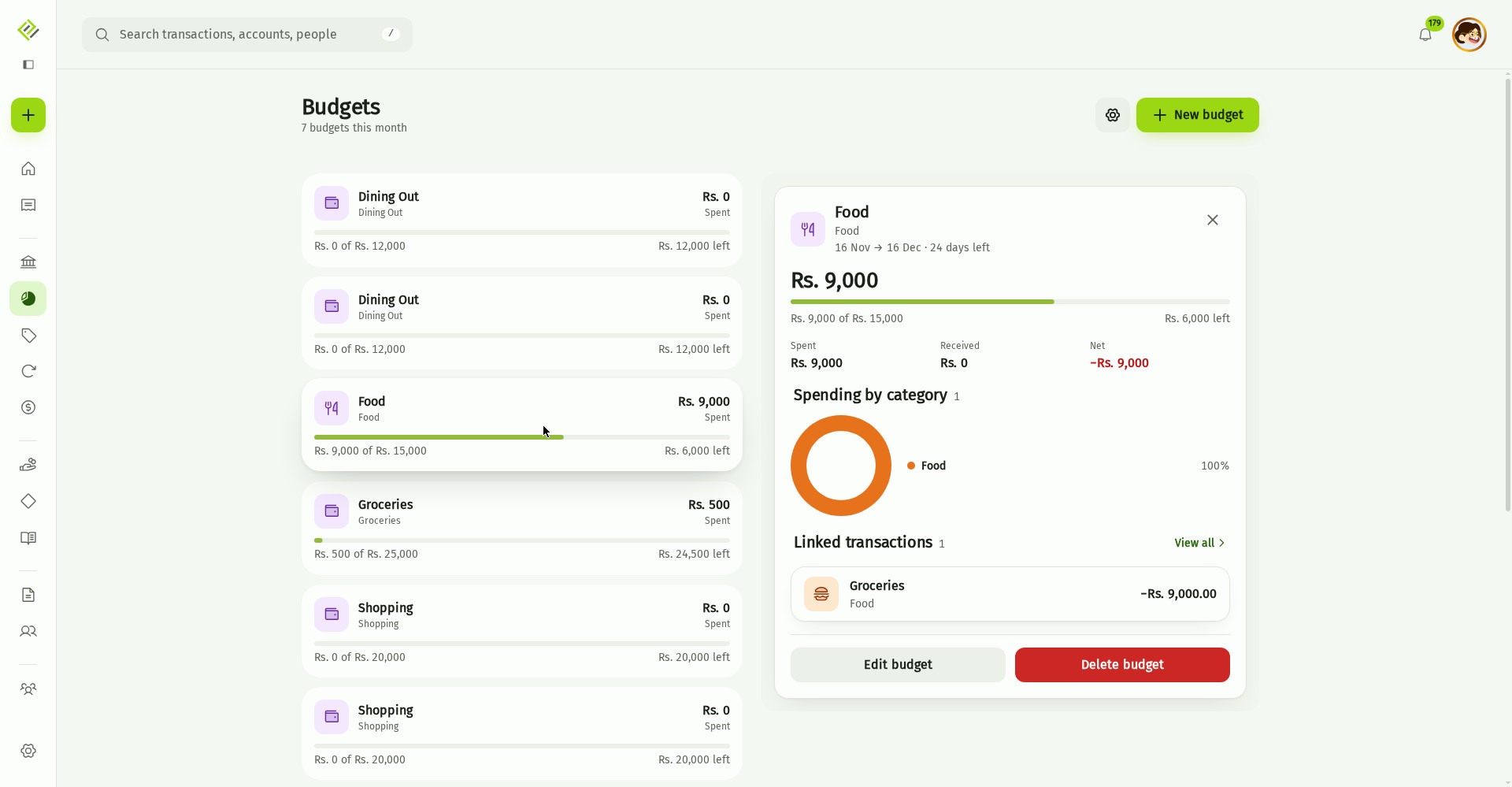
The budget screen below shows what that looks like in practice: Rs 9,000 spent of a Rs 15,000 limit, Rs 6,000 left, running 16 November to 16 December with 24 days left.
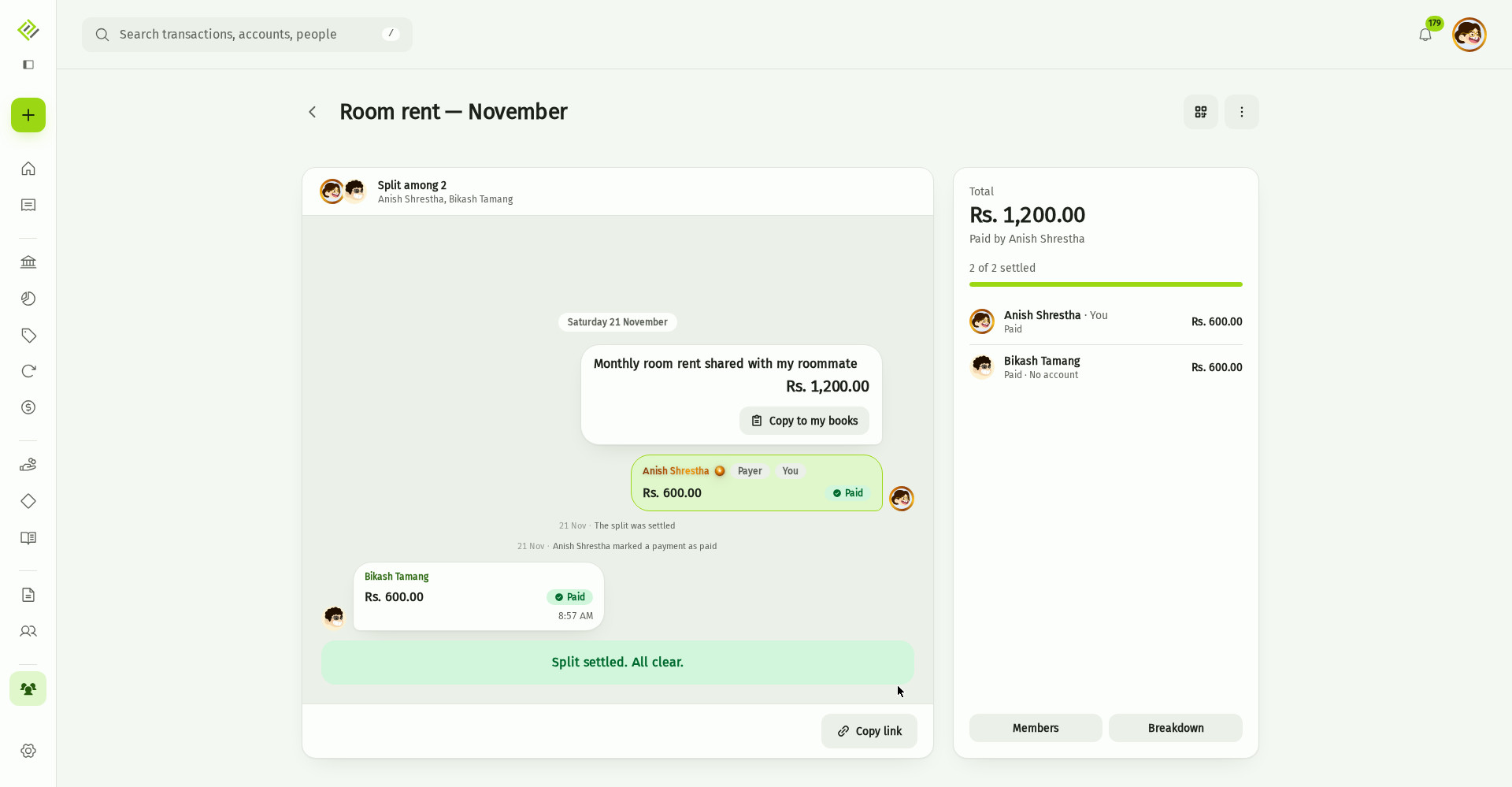
The split below shows how the shared half ends: "Room rent, November", Rs 1,200 in total, paid by Anish Shrestha and split equally with Bikash Tamang, Rs 600 each. Both marked paid, and the app shows "Split settled. All clear." with 2 of 2 settled.
PocketGuard has no way to split a cost between two people. Its own pages describe no shared account and no split feature, and a customer note about a husband and a household on its pricing page is a note, not a feature. Shared money is the half of the month PocketGuard leaves outside the app, and it is the half Lipi handles free. The full flow is in How to split expenses with friends in Lipi, and Expense tracker app for couples: Lipi for shared budgets and splits covers the same shape for a household.
Lipi and PocketGuard, side by side
The table judges one job: tracking your money without depending on a bank link. Free to start, manual entry that works offline, splits between two people, a debt payoff plan, subscription tracking, loan tracking, receipt records and the price after any free period are the criteria. Competitor facts are as of 22 November 2026.
| Feature | Lipi | PocketGuard | YNAB | EveryDollar |
|---|---|---|---|---|
| Free to start | Yes | 7-day trial only, no free plan | 34-day trial, then paid | Yes, manual entry |
| Works without a bank link | Yes, manual and offline | Yes, manual entry and cash accounts | Yes, manual entry | Yes, manual entry |
| Splits between two people, free | Yes | No | No | No |
| Debt payoff plan | No, loans and EMI only | Yes, avalanche or snowball with a debt-free date | No | Yes, snowball tracker (Premium) |
| Subscription tracking | Recorded as recurring expenses | Yes, detected automatically with alerts | Recorded by hand | Recorded by hand |
| Loans and EMI tracking | Yes, with prepayment | Yes, loan accounts link and feed Leftover | Yes, loan accounts with payoff planner | No |
| Receipt records | Yes, 5 smart scans a month free | Yes, receipt photos | No | No |
| Price after any free period | USD 3 a month, or USD 2 a month billed yearly (USD 24) | $74.99 a year | $109 a year | $79.99 a year |
Lipi takes the overall verdict for manual tracking without a subscription because it is the only app in the table that is free to start, works offline with no bank link, splits between two people for free, and tracks loans and EMI, all in the same book. PocketGuard has the strongest single number in the group and a debt payoff plan, but it costs $74.99 a year to open, its sync is the top complaint in its own low-star reviews, and it has no splits. YNAB has the strongest budgeting method and no splits either, at $109 a year. EveryDollar is free to start with manual entry, but it has no splits, no loan tracking and no receipt records.
What it costs
Prices are each app's published rate as of 22 November 2026.
| App | Free plan | Paid price | What the free plan gives you |
|---|---|---|---|
| Lipi | Yes | Premium USD 3 a month, or USD 2 a month billed yearly (USD 24) | Tracking, 3 active budgets, 2 accounts, splits free |
| PocketGuard | 7-day trial only | Plus $74.99 a year, or $12.99 a month, or $149.99 lifetime | Trial only, no free plan |
| YNAB | 34-day trial | $109 a year | Full product for 34 days, then $14.99 a month or $109 a year |
| Monarch | 7-day trial only | Core $99.99 a year | Trial only, no free plan |
| EveryDollar | Yes, manual entry | Premium $79.99 a year | Full zero-based budget by hand |
| Rocket Money | Yes | Premium $7 to $14 a month | Subscription tracking, spending insights |
| Wallet | Yes, manual tracking | Lifetime Premium $29.99 | Manual tracking, multi-currency |
| Money Lover | Yes, ads, one wallet | Premium one-time $19.99 | One wallet, budgets, ads |
| Spendee | Yes, one wallet, one budget | Plus $3.99 a month; Premium $7.99 a month | One cash wallet, one total budget |
One year of PocketGuard Plus at $74.99 is about 25 months of Lipi Premium at USD 3 a month. Over five years, Lipi Premium is $120 billed yearly. PocketGuard Plus at $74.99 a year is $374.95, and at $12.99 a month it is $779.40. The $149.99 lifetime plan is $29.99 more than five years of Lipi Premium billed yearly, and it ends if PocketGuard shuts down, with no refund. YNAB at $109 a year is $545 over five years, Monarch at $99.99 a year is $499.95, and EveryDollar Premium at $79.99 a year is $399.95. Money Lover's one-time $19.99 and Wallet's lifetime plan at $29.99 are the cheapest paid options in the table, and both are still payments for tracking Lipi gives free.
The free-plan limit, stated plainly
Lipi's free plan holds 2 accounts and 3 active budgets. That fits a cash account and one bank account, and three budgets for food, transport and fun, for example. It does not fit four accounts at once, and a person who wants a cash account, a bank account, a card account and a savings account together needs Premium for the extra accounts. Premium lifts the cap, and it costs USD 3 a month, or USD 2 a month billed yearly (USD 24). This page does not pretend the free plan holds more than two accounts, because it does not.
The same honesty applies to the rest of the free plan. Splits are free, invoices and clients are free, and receipt scanning gives 5 smart scans a month free, with further receipts saving as attachments. Recurring and scheduled creation, the Bills radar, data export and statement import are Premium. A person who only needs tracking, budgets and splits can stay free, and that free plan is the whole product, not seven days of it.
What Lipi does not do
A page that only lists strengths is a brochure, so here is the other side, stated as plainly as the strengths.
Lipi does not link to a bank account or import transactions automatically, and it never will by design: manual entry is the trade for working offline and without a bank login. It does not build a debt payoff plan with a projected debt-free date, though it does track loans and EMI, with prepayment. It does not detect subscriptions automatically or cancel them for you, though it does record them as recurring expenses so you can see what they cost. It does not negotiate bills for a share of the savings. It does not track shares or investments, and it never presents them as a capability. And it does not collapse bills, goals and budgets into one safe-to-spend number: each budget shows what is left, and the total is the sum of those figures.
Those limits are acceptable for most people leaving PocketGuard and disqualifying for a few. A person whose bank links cleanly, who opens the debt payoff planner every day, and who wants one number after bills will get their money's worth from PocketGuard Plus. A person whose bank kept disconnecting, who was charged after a trial, or who wants tracking without a subscription needs a book that is always current and free at the point where the money is tightest. How to track expenses without linking your bank account works through the manual method in full.
Questions people ask before switching
What is the best free alternative to PocketGuard?
The one that is free to start, works without a bank link, splits costs between two people, and costs almost nothing when the free period ends, because there is no free period to end. Lipi covers all four, with splits free and Premium at USD 3 a month, or USD 2 a month billed yearly (USD 24). The third-party roundups name Herbert, Empower, Rocket Money, Monarch, YNAB and Simplifi, but every one of those either needs a bank link, costs a subscription, or both. Goodbudget is the closest free manual option in those roundups.
Is PocketGuard free?
No. New accounts start on a seven-day free trial of PocketGuard Plus, and the pricing page lists no free plan. Older pages describe a limited free version capped at two linked accounts and two budget categories, and a basic mode sometimes appears after you decline the trial, but sign-up never offers it, and one September 2026 review reported the free version was gone and the app would not open without a subscription. Treat the seven days as the free period, and put the end of it in your calendar on the day you start.
Is PocketGuard worth $74.99 a year?
It is worth it if you use the debt payoff plan and the automatic bill detection every month, and if your banks stay connected. It is not worth it if your bank is one of the thirteen on its own help page with sync issues and no fix date, or if you mainly need tracking, budgets and splits, which Lipi gives free. The lifetime plan at $149.99 saves money from the third year against the annual plan, but it ends if PocketGuard shuts down, with no refund.
Can I track expenses without linking my bank account?
Yes. Lipi is manual and offline by design, with no bank link at all. EveryDollar's manual budget is free, Money Lover is free with ads and one wallet, and Wallet is free with manual tracking. PocketGuard also accepts manual entries and cash accounts, but the app is built around the link, and the free period is seven days.
Does Lipi have a debt payoff plan?
No. Lipi tracks loans and EMI, with prepayment that reduces EMI or tenure and shows the interest saved, but it does not build an avalanche or snowball plan with a projected debt-free date. That is PocketGuard's feature, and it is the one honest reason to pay for PocketGuard Plus.
How do I cancel PocketGuard?
A plan bought on PocketGuard's website is cancelled in the web app under Settings, then Customer Portal, not in the store subscriptions. Cancel before the seven days run out, because trials tend to convert to the $74.99 yearly plan rather than the monthly one. Best expense tracker apps: 8 compared on price, currencies, gold, loans and splits puts Lipi against the rest of the field, including the apps in the price table above.
The short version
PocketGuard's one number is good, its debt payoff plan is real, and its bank sync is the reason people leave: it drops, it duplicates, it charges after the trial, and it costs $74.99 a year to open.
Open Lipi and set up your PocketGuard replacement today. The manual entry, the budgets and the splits are all in there, they stay current because the entries take seconds, and there is no trial clock running on any of it.
Sources
- Best expense tracker apps: 8 compared on price, currencies, gold, loans and splits, Lipi (read 22 November 2026)
- Expense tracker app for couples: Lipi for shared budgets and splits, Lipi (read 22 November 2026)
- How to split expenses with friends in Lipi, Lipi (read 22 November 2026)
- How to track expenses without linking your bank account, Lipi (read 22 November 2026)
Keep reading
Guide
Free alternative to EveryDollar: Lipi for zero-based budgeting without the locked months
Lipi is the free alternative to EveryDollar for zero-based budgeting without locked months: past months stay editable, budgets and splits are free, and Premium costs USD 3 a month or USD 2 a month billed yearly (USD 24).
20 min read
Guide
Free alternative to Monarch: Lipi for manual tracking without the subscription
Lipi is the free alternative to Monarch for people who want manual tracking without a subscription: free to start, budgets and splits free, and accounts in more than one currency in one book. Monarch Core costs $99.99 a year after a 7-day trial, with no free plan.
18 min read2 views
Guide
Free alternative to Toshl: Lipi for multi-currency tracking that converts properly
Lipi is the free alternative to Toshl: multi-currency tracking that converts at the real rate, budgets and splits free, and no subscription to see your own money. Premium costs USD 3 a month, or USD 2 a month billed yearly (USD 24).
17 min read
Guide
How to track expenses in multiple currencies
Give every currency its own account, and let one total convert at the day's rate. This page shows the method, the conversion bugs other apps ship with, a worked example at today's live rate, and what each app costs. Free to start with 2 accounts and 3 budgets. Premium USD 3 a month, or USD 2 a month billed yearly (USD 24).
18 min read