Guide
YNAB vs Lipi: which tracker wins for budgeting without the subscription?
Lipi wins for budgeting without the subscription: free to start, budgets and splits free, and multi-currency accounts in one book. YNAB has the stronger method and linked accounts, at $109 a year.
By Bikram LamaPublished 16 min read1 view
Lipi wins for budgeting without the subscription.
YNAB is the better teacher. Its method changes how people think about money, and the people it clicks for stay for years. Lipi is the better deal for everyone else: the budget, the tracking and the splitting are free to start, the book works offline with no bank login, and Premium costs USD 3 a month, or USD 2 a month billed yearly (USD 24). A year of YNAB costs $109, against $24 for a year of Lipi Premium billed yearly. That is the whole comparison in one line, and the rest of this page is the evidence for it.
Open Lipi and set up your first budget today. Tracking, budgets and splits are free, and the setup takes an evening.
Why people put these two side by side
Nobody compares YNAB and Lipi because the apps look alike. They compare them because YNAB is the budgeting app most people have heard of, and Lipi is the one people find when the subscription starts to sting. The low-star reviews of YNAB repeat the same three complaints, and each one points at the same decision: pay $109 a year, or budget without the bill.
The first complaint is the price, and it comes from people who like the app. A 4-star App Store review from September 2026 reads:
"I really like YNAB but I think it's too expensive."
A reviewer on G2, a ten-year user who gave the app 0 out of 5 in January 2025, puts the same point slower:
"Once you know what you are doing, YNAB becomes just another expense. As a 10 year user of YNAB it's just become too expensive. My habits are already formed and I can find cheaper software that..."
A Trustpilot review from 22 October 2026 remembers when YNAB was not a subscription at all:
"I purchased YNAB back in the day with a one-time payment, and it's messed up that I eventually had to move to a subscription."
The price history explains the tone. YNAB raised its price from $84 to $99 to $109 over three years, and each rise brought a wave of one-star reviews from long-time users. A Google Play review from 27 February 2026 weighs the price against what the app gives:
"...the features are a little sparse as is, for the over $100 price tag. I'll be debating whether to renew this year."
The second complaint is the sync. YNAB sells linked accounts as the easy route, and when the link lags, the app loses its main reason to pay. A 1-star App Store review from October 2026 reads:
"This app used to be great for tracking spending and making a budget but it now takes 12-24 hours to sync transactions."
A Google Play review from 27 February 2026 paid for the same feature and got the manual work anyway:
"paid for the subscription so I could link my accounts automatically, but they rarely / never work. Im constantly resetting them or adding transactions manually..."
Across the five most downloaded budgeting apps, bank sync failures are 34% of negative reviews, subscription price shock is 22%, and sync delays of 6 to 24 hours are 7%. YNAB's direct import covers selected banks in the US, Canada, the UK and the EU, and outside those regions the route is file-based import. Reviews from 2026 describe delayed or dropped syncs, and the wait is the complaint.
The third complaint is the workload. YNAB asks you to give every dollar a job before you spend it, then reconcile what actually happened, every week. One App Store review in a study of 1,586 one- and two-star reviews puts it plainly:
"It overwhelmed me by giving me another 'job' to do. I needed to reduce my cognitive load, not add to it."
Reviewers who stick with it estimate two to four months before the method fully clicks. That is not a flaw in the method. It is the price of the method, paid in time instead of money, and it is the reason this page exists: plenty of people want the budget without the second job and without the subscription.
What YNAB does well
This page would be dishonest if it pretended YNAB had nothing going for it. The method is the real thing. Give every dollar a job before it is spent, plan for irregular costs before they arrive, and move money between categories when life changes the plan. People who learn it stop being surprised by their own money, and the education around it, workshops, guides and support, is the reason people stay subscribed for years. One five-star reviewer in September 2026 says ten years of YNAB took them from $250,000 in debt to $950,000 in net worth.
The loan planner is real too. YNAB has loan accounts with a payoff planner, so a loan is a schedule with a finish date, not a monthly amount you hope shrinks. Linked accounts, where they work, pull transactions in by themselves. And one subscription covers up to six people through YNAB Together, which is good value for a household that all wants the method.
Lipi does not teach a method. Its budgets are monthly category budgets: set a limit, log what you spend, see what is left. That is a thinner product in one sense and a lighter one in another. You do not need two to four months to learn it, and you do not pay $109 a year for the lesson.
YNAB and Lipi, side by side
The table judges one job: budgeting your money without paying a subscription for the privilege. Free to start, manual entry that works offline, budgets that cover the month, splitting one bill between two people, loans and EMI, gold by weight, more than one currency in one book, and the price after any free period are the criteria. Competitor facts are as of 24 November 2026.
| Feature | Lipi | YNAB |
|---|---|---|
| Free to start | Yes, 2 accounts and 3 budgets | No, 34-day trial, then paid |
| Price after any free period | Premium USD 3 a month, or USD 2 a month billed yearly (USD 24) | $14.99 a month or $109 a year |
| Budgeting method | Monthly category budgets, set a limit and watch it run down | Zero-based method, give every dollar a job before spending it |
| Works without a bank link | Yes, manual and offline by design | Yes, manual entry, but built around linked accounts |
| Accounts in more than one currency | Yes, each account in its own currency with a converted total | No, one currency per spending plan |
| Splitting one bill between two people | Yes, free, one bill per split, with a settle-up balance | No shared-cost split described |
| Loans and EMI | Yes, with prepayment to reduce EMI or tenure | Yes, loan accounts with payoff planner |
| Gold tracked by weight, with live value | Yes, tola, lal and grams | No |
| Sharing with another person | Yes, shared accounts and splits free | Yes, up to six people on one subscription, group manager sees every member plan |
| Receipt records | Yes, 5 smart scans a month free | No |
| Works offline | Yes | Manual entry works offline |
| Free for students | Free plan for everyone | Free 12 months for verified college students with proof of enrolment |
Lipi takes the overall verdict for budgeting without the subscription because it is the only app in the table that is free to start, works offline with no bank link, splits one bill between two people for free, tracks loans and EMI and gold by weight, and holds accounts in more than one currency, all in the same book. YNAB has the stronger method and the loan planner, and its one subscription covering six people is good value if the whole household wants the method. But the method costs $109 a year, the plan runs in one currency, and there is no way to split a cost between two people inside the app.
A month in Lipi, with real numbers
Take a month on a pay of Rs. 90,000. The budgets below are the month as it is set up in Lipi, with the figures the app itself shows.
| Budget | Monthly limit | Spent so far | Left |
|---|---|---|---|
| Rent | Rs. 30,000 | Rs. 30,000 | Rs. 0 |
| Food | Rs. 15,000 | Rs. 9,000 | Rs. 6,000 |
| Transport | Rs. 10,000 | Rs. 4,200 | Rs. 5,800 |
| Loan EMI | Rs. 12,500 | Rs. 12,500 | Rs. 0 |
| Fun | Rs. 5,000 | Rs. 1,800 | Rs. 3,200 |
| Total planned | Rs. 72,500 | Rs. 57,500 | Rs. 15,000 |
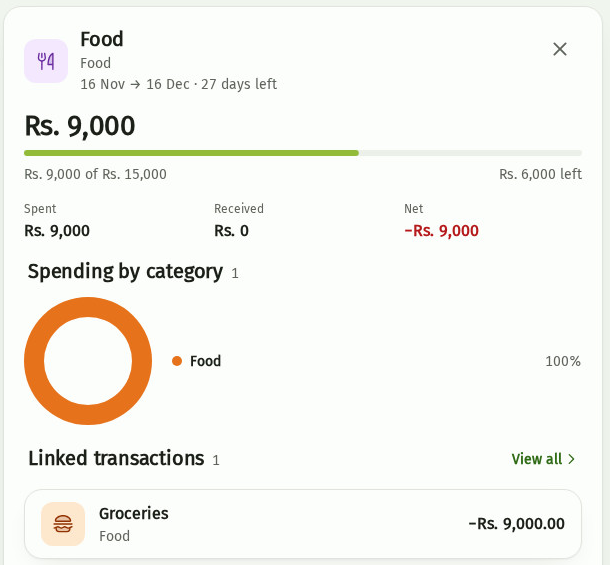
The Food budget is the one the screenshot below shows: Rs. 9,000 spent of a Rs. 15,000 limit, Rs. 6,000 left, running 16 November to 16 December with 27 days left. With Repeat on, a Lipi budget repeats monthly by default, so next month starts with the same budget and the same limit. The Repeat switch itself is off by default, so a budget you set up for one month stays a one-month budget unless you turn it on.
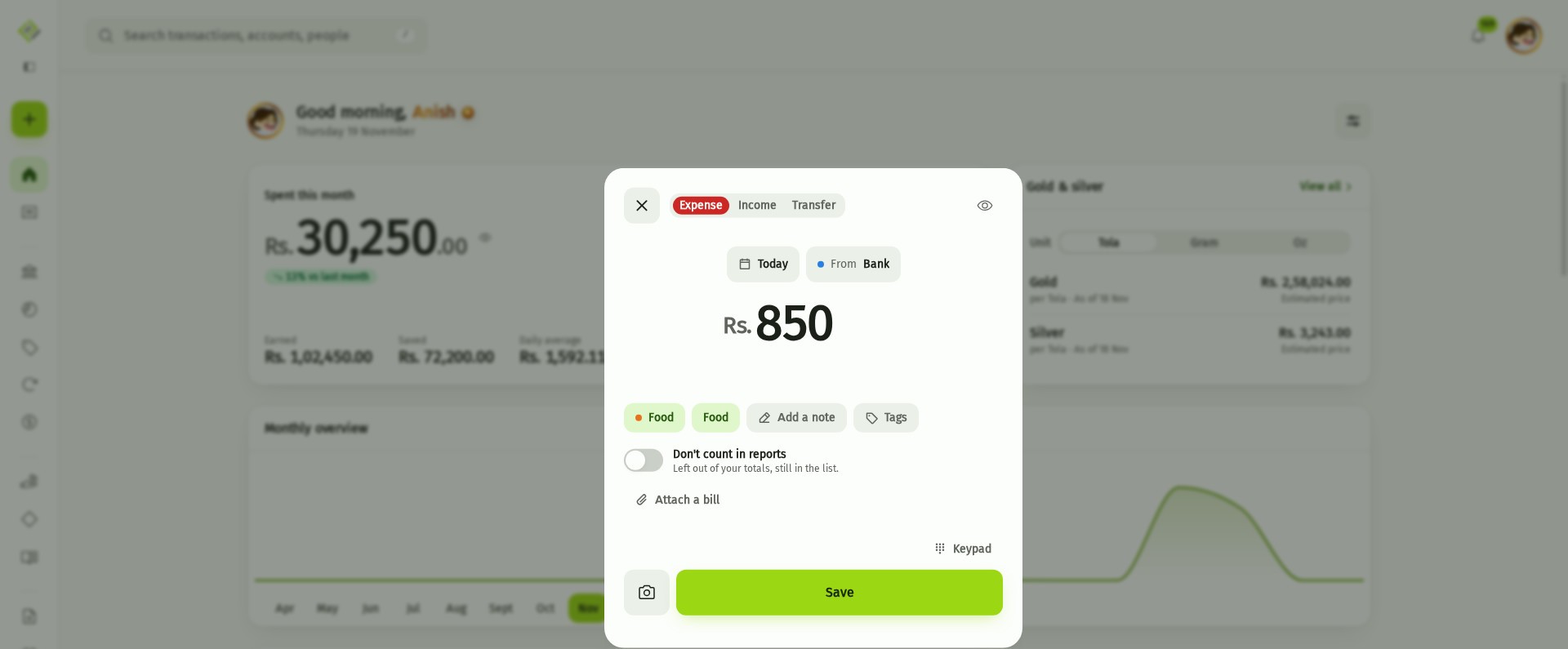
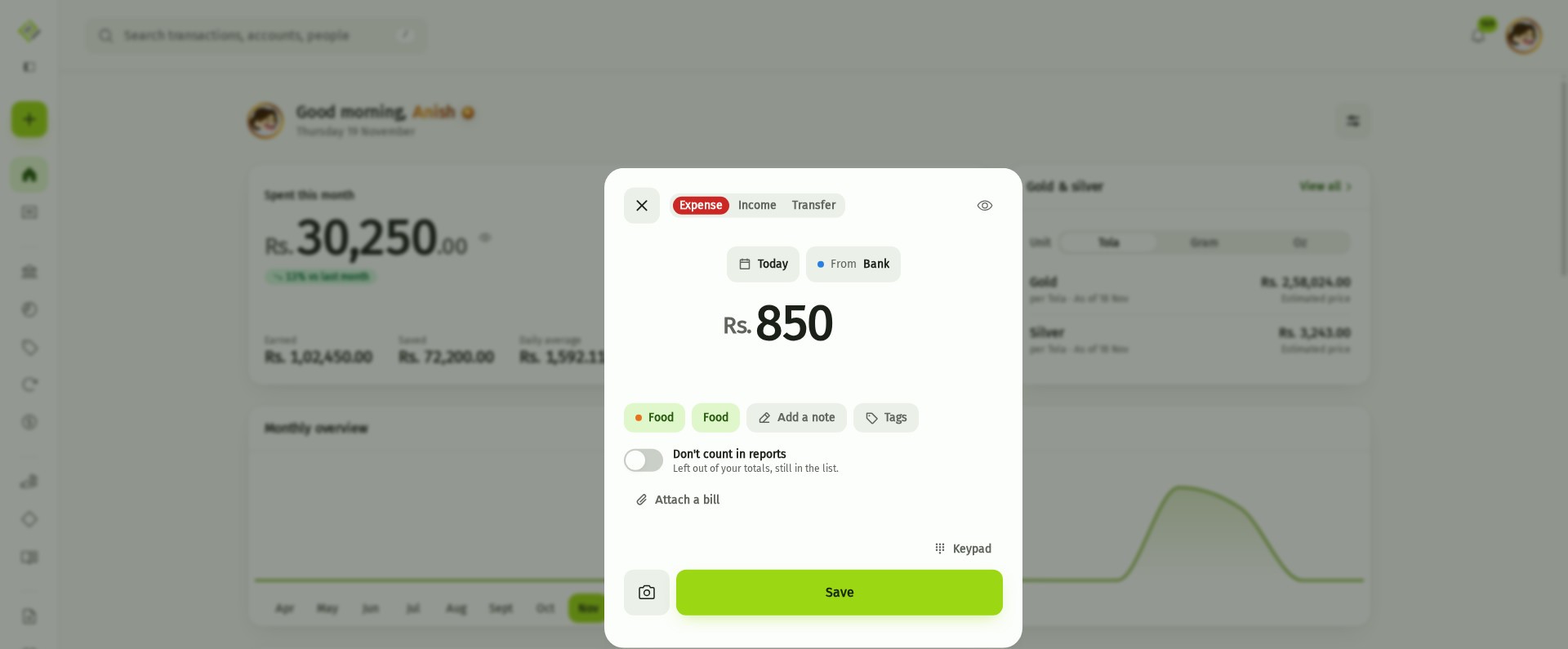
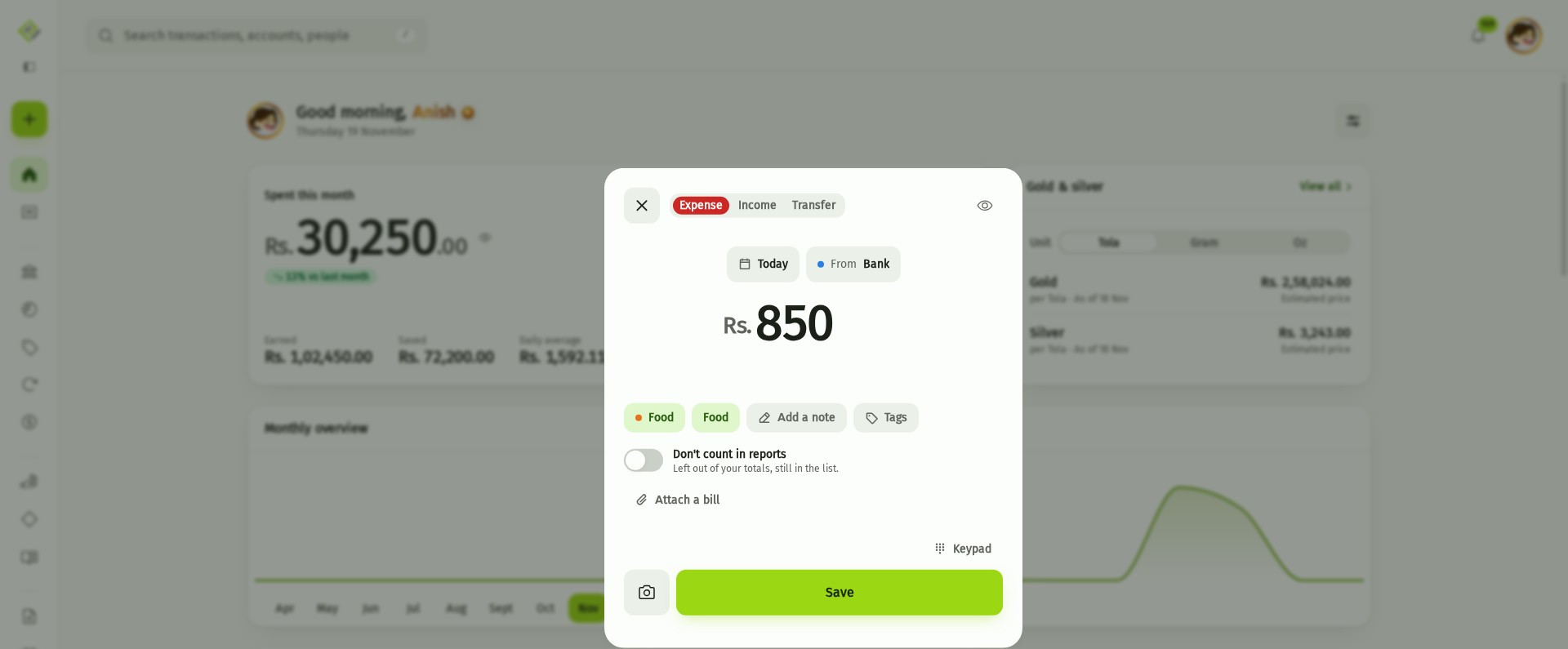
Logging takes seconds, by hand, and that is the whole point of the manual method. The add expense dialog at the top of this page shows a grocery run of Rs. 850 for Food, paid from Bank, with Expense, Income and Transfer tabs across the top. Type the amount, pick the category, save. The Food budget moves from Rs. 9,000 to Rs. 9,850 the moment you save it, and the entry is in the book because you made it, not because a feed arrived twelve hours later.
The same month in YNAB would ask for the same discipline with one extra step: every dollar gets a job before it is spent, and the credit card handling takes weeks to learn. The month above needs no lesson. Rent, food, transport, the loan and fun each have a limit, and the Rs. 15,000 left at the bottom is the month's breathing room. A shared dinner in that month goes on a split, not into one person's budget: one bill, equal or custom shares, and the breakdown shows who owes whom until everyone has marked paid. The splits guide shows the settle flow step by step.
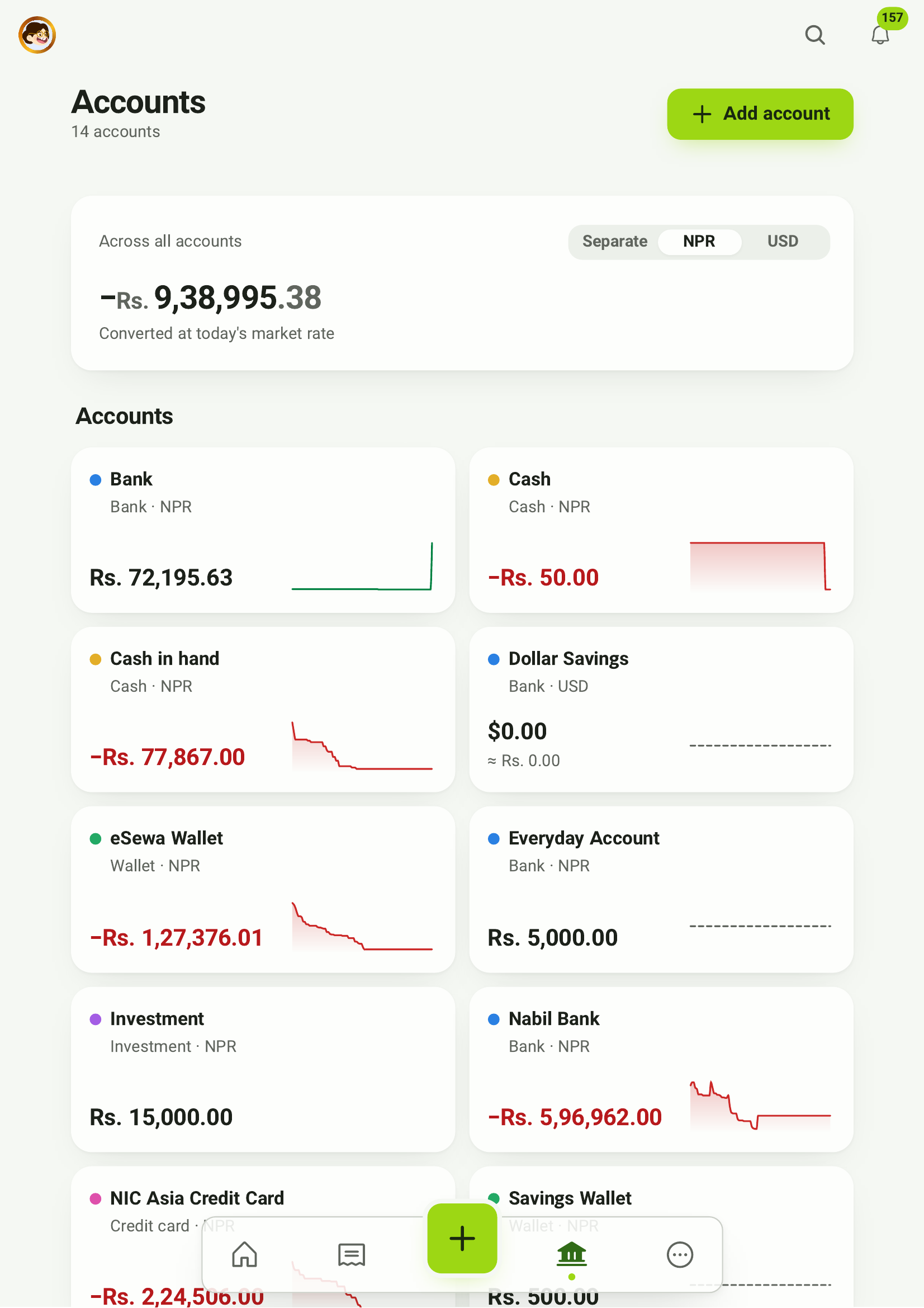
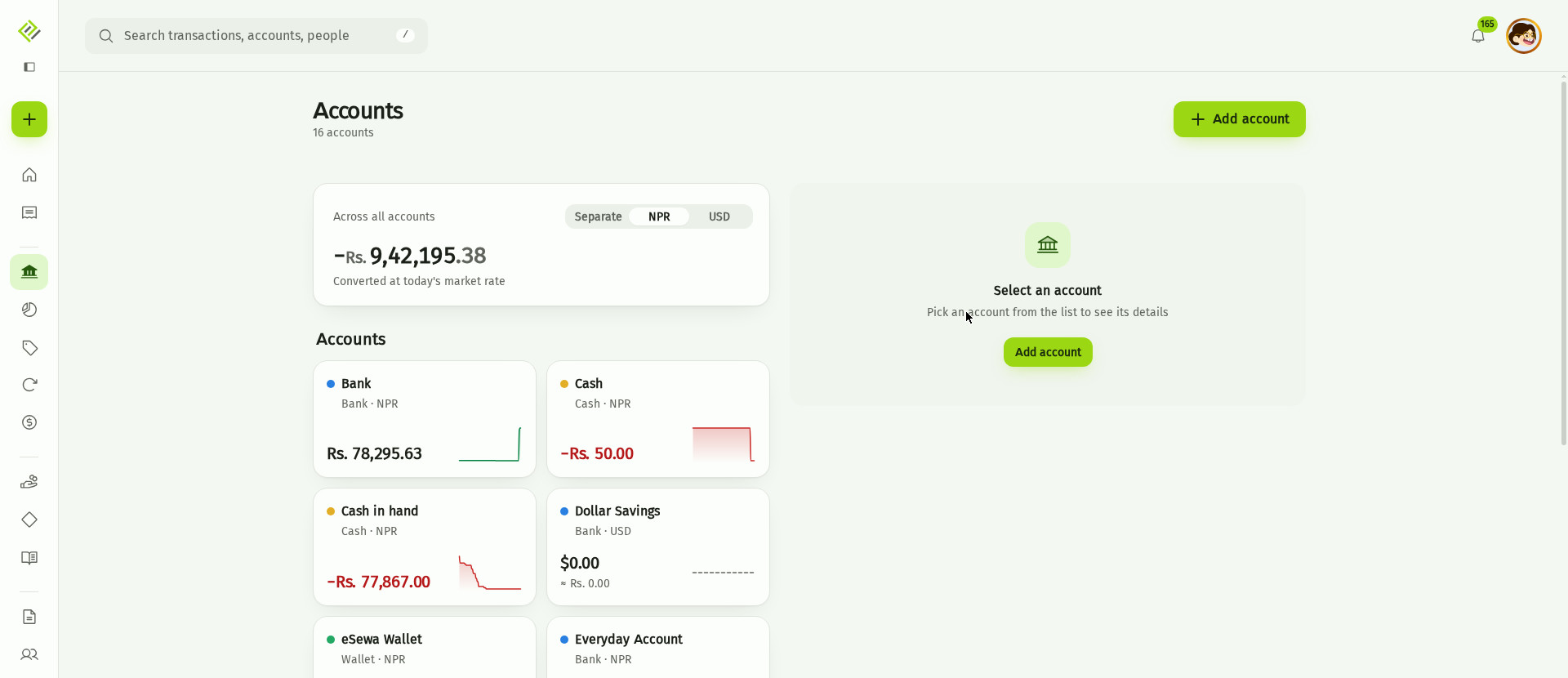
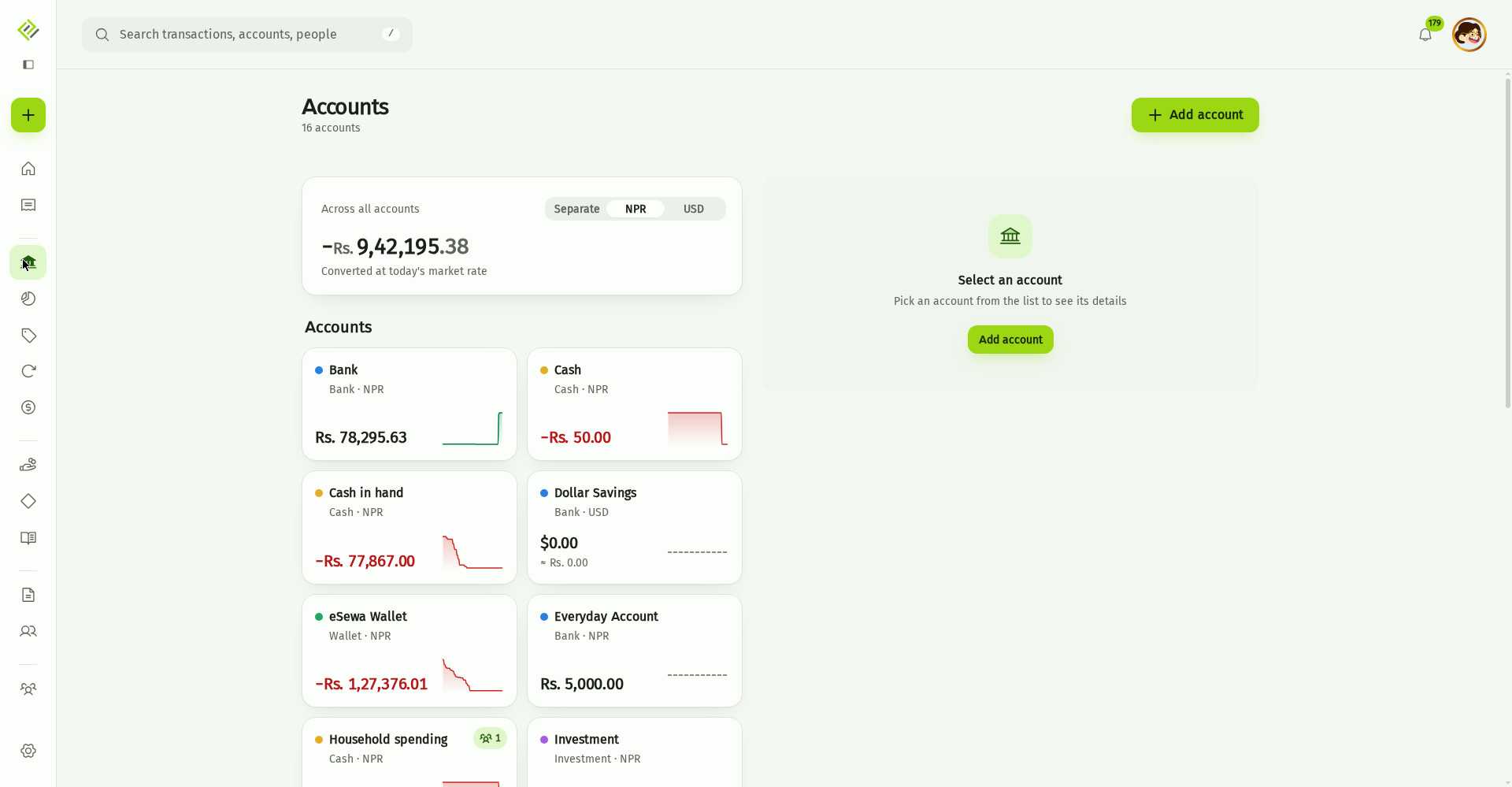
The accounts page shows how the multi-currency side works. A bank account in NPR reads Rs. 72,195.63. A Dollar Savings account reads $0.00, with its converted value underneath. Every account keeps its own currency, and the page carries one converted total across all accounts, labelled "Converted at today's market rate". YNAB runs one currency per plan, so the same month in two currencies needs two plans.
What it costs
Prices are each app's published rate as of 24 November 2026.
| App | Free plan | Paid price | What the free plan gives you |
|---|---|---|---|
| Lipi | Yes | Premium USD 3 a month, or USD 2 a month billed yearly (USD 24) | Tracking, 2 accounts, 3 active budgets, splits free |
| YNAB | 34-day trial, no free plan | $109 a year, or $14.99 a month | Full product for 34 days, then paid |
| YNAB for students | Free 12 months with proof of enrolment | $109 a year after the free year | Full product for 12 months |
Two months of YNAB at $14.99 cost more than a year of Lipi Premium billed yearly, which is $24. One year of YNAB at $109 buys about four and a half years of Lipi Premium. Over five years, YNAB at $109 a year costs $545. Lipi Premium costs $120 over five years billed yearly. The gap is $425. On YNAB monthly billing the five-year cost is $899.40, and the gap against Lipi Premium is $719.40.
The student offer softens the first year only. Verified college students get 12 months free with proof of enrolment, then the price is $109 a year, the same cliff every other user faces.
For the longer price story, Free alternative to YNAB: Lipi for budgeting without the subscription goes deeper on the price wedge and the method question. This page is the head-to-head verdict; that page is the leaving-YNAB guide.
The free-plan limit, stated plainly
Lipi's free plan holds 2 accounts and 3 active budgets. That fits a cash account and one bank account, and three budgets for food, transport and fun, for example. It does not fit four accounts at once, and a person who wants a cash account, a bank account, a card account and a savings account together needs Premium for the extra accounts. Premium lifts the cap, and it costs USD 3 a month, or USD 2 a month billed yearly (USD 24). YNAB has no free plan at all: after 34 days the choice is $14.99 a month or $109 a year, or the app stops.
The same honesty applies to the rest of the free plan. Splits are free, invoices and clients are free, and receipt scanning gives 5 smart scans a month free, with further receipts saving as attachments. Recurring and scheduled creation, the Bills radar, data export and statement import are Premium. A person who only needs tracking, budgets and splits can stay free, and that free plan is the whole product, not thirty-four days of it.
What Lipi does not do
A page that only lists strengths is a brochure, so here is the other side, stated as plainly as the strengths.
Lipi does not link to a bank account or import transactions automatically, and it never will by design: manual entry is the trade for working offline and without a bank login. If linked accounts are the feature you open every day, YNAB earns its price, and this page says so. The honest pick for a person whose bank links cleanly and who wants transactions to arrive by themselves is YNAB, not Lipi.
Lipi does not teach a budgeting method. YNAB's four rules are a real discipline, taught properly, and Lipi has no equivalent. If the method is what changed your spending before, Lipi's monthly budgets will feel thin by comparison. Lipi does not track shares or investments, and it never presents them as a capability. It does not detect subscriptions automatically or cancel them for you, though it does record them as recurring expenses so you can see what they cost. And it does not collapse bills, goals and budgets into one safe-to-spend number: each budget shows what is left, and the total is the sum of those figures.
My view, after reading the reviews for this page: people do not quit YNAB because the method failed them. They quit because the subscription kept rising while the sync kept lagging, or because the weekly upkeep outlasted their patience. Lipi fixes the things people actually quit over: the price, the waiting, and the second job. It does not fix the method, because it does not try to. For a person who wants a budget that is simply there, typed in seconds and free at the point where the money is tightest, that is the better trade. For a person who wants the method and the linked accounts and will pay $109 a year for both, YNAB is the right app, and nothing on this page pretends otherwise.
How to track expenses without linking your bank account works through the manual method in full, and Best expense tracker apps: 8 compared on price, currencies, gold, loans and splits puts Lipi against the rest of the field, including YNAB.
Questions people ask before choosing
Is YNAB worth it?
Yes, for the person who wants the method and will work it every week. The method changes behaviour in a way a passive tracker does not, and the people it clicks for stay for years. No, for the person who wants a budget without a subscription and without a weekly reconciliation habit. That person pays $109 a year for a lesson they did not ask for, and Lipi gives them the budget free.
Is YNAB free?
No. There is no free plan. You get 34 days free with no card when you sign up directly through YNAB, then the choice is $14.99 a month or $109 a year. Verified college students get 12 months free with proof of enrolment.
How much does YNAB cost?
$14.99 a month or $109 a year, plus tax where it applies. Monthly billing over a year is $179.88, which is $70.88 more than the annual plan. Over five years the annual plan costs $545 and monthly billing costs $899.40. Prices are from YNAB's own pricing page, checked 24 November 2026.
Does YNAB split shared bills between two people?
Not as the app describes it. YNAB Together shares one subscription with up to six people, and the group manager sees every plan the members create, but YNAB's own pages describe no way to split a cost between two people. Who owes whom gets worked out outside the app. In Lipi a split is one bill between people, with a settle-up balance, and it is free. Expense tracker app for families: Lipi for shared budgets, splits and allowance shows the same setup for a household.
Can my partner see everything in my YNAB?
The group manager sees every plan a member creates. A member sees the plans shared with them and can edit them, but cannot manage sharing, delete the plan or start a fresh one. If you keep an account you want private from the person who pays, YNAB Together does not give you that.
Which is better for couples, YNAB or Lipi?
YNAB, if both of you want the method and one subscription covering six people. Lipi, if you want to split the bills and see who owes whom without paying for the privilege. The couples page for Lipi covers the shared setup in full, and the YNAB alternative page covers the price question.
The short version
YNAB has the better method and the loan planner, and its one subscription covers six people. It also costs $109 a year, runs one currency per plan, takes 12 to 24 hours to show some transactions, asks for a weekly habit, and cannot split a bill between two people.
Open Lipi and set up your first budget today. The tracking, the budgets and the splits are all in there, the book works offline, and there is no trial clock running on any of it.
Sources
- Free alternative to YNAB: Lipi for budgeting without the subscription, Lipi (read 24 November 2026)
- How to track expenses without linking your bank account, Lipi (read 24 November 2026)
- Best expense tracker apps: 8 compared on price, currencies, gold, loans and splits, Lipi (read 24 November 2026)
- Expense tracker app for families: Lipi for shared budgets, splits and allowance, Lipi (read 24 November 2026)
- How to split expenses with friends in Lipi, Lipi (read 24 November 2026)
Keep reading
Guide
Free alternative to EveryDollar: Lipi for zero-based budgeting without the locked months
Lipi is the free alternative to EveryDollar for zero-based budgeting without locked months: past months stay editable, budgets and splits are free, and Premium costs USD 3 a month or USD 2 a month billed yearly (USD 24).
20 min read
Guide
Free alternative to Monarch: Lipi for manual tracking without the subscription
Lipi is the free alternative to Monarch for people who want manual tracking without a subscription: free to start, budgets and splits free, and accounts in more than one currency in one book. Monarch Core costs $99.99 a year after a 7-day trial, with no free plan.
18 min read2 views
Guide
How to track expenses in multiple currencies
Give every currency its own account, and let one total convert at the day's rate. This page shows the method, the conversion bugs other apps ship with, a worked example at today's live rate, and what each app costs. Free to start with 2 accounts and 3 budgets. Premium USD 3 a month, or USD 2 a month billed yearly (USD 24).
18 min read
Guide
Free alternative to Toshl: Lipi for multi-currency tracking that converts properly
Lipi is the free alternative to Toshl: multi-currency tracking that converts at the real rate, budgets and splits free, and no subscription to see your own money. Premium costs USD 3 a month, or USD 2 a month billed yearly (USD 24).
17 min read