Guide
Free alternative to Wallet by BudgetBakers: Lipi for manual tracking
Lipi is the free alternative to Wallet by BudgetBakers for manual tracking: entries typed by hand with no bank login to break, 2 accounts and 3 budgets free, custom categories, multi-currency accounts, gold and loans in one book. Premium costs USD 3 a month, or USD 2 a month billed yearly (USD 24).
By Bikram LamaPublished Updated 16 min read1 view
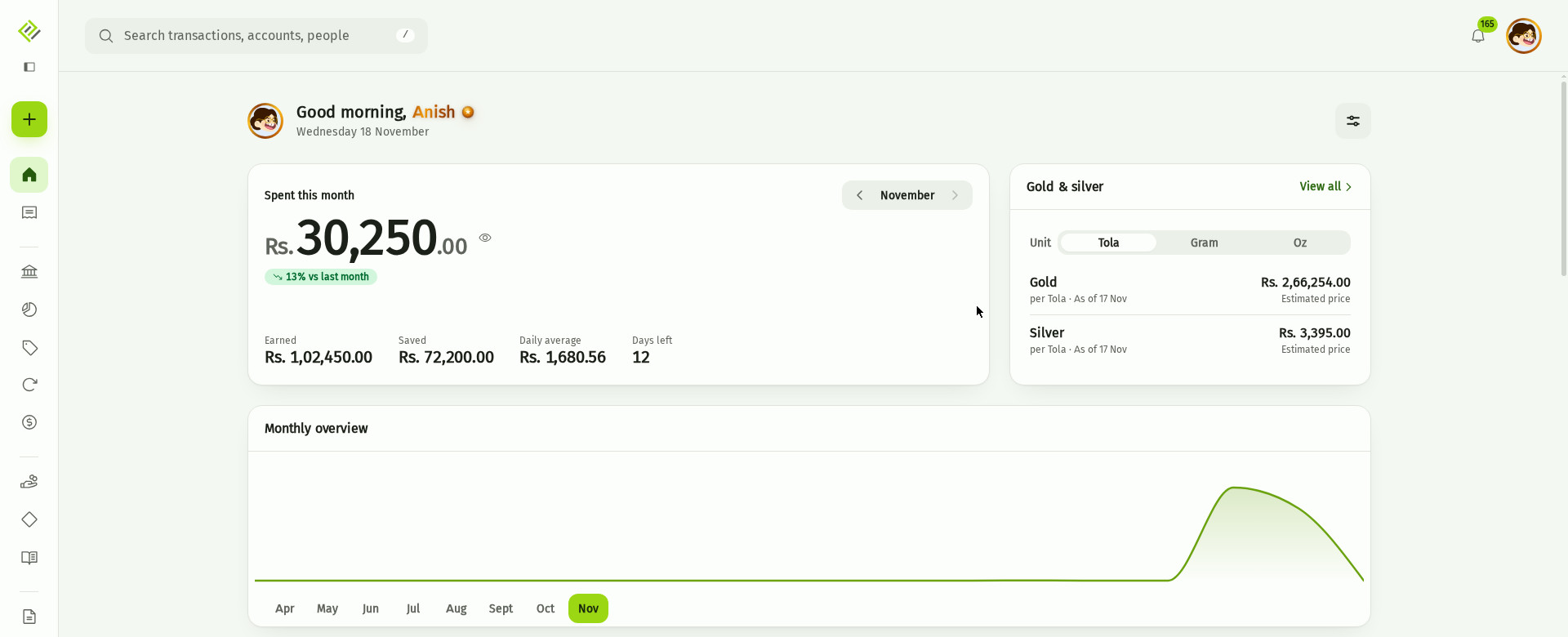
Lipi is the free alternative to Wallet by BudgetBakers for manual tracking.
Wallet is a strong app when its bank sync holds. When the sync breaks, the app turns into repair work. Lipi takes the other road: you type each entry by hand, the book works with no connection, and nothing in it depends on a bank feed.
Open Lipi and log today's first expense by hand. The entry takes the same few taps, in a book that asks for no bank login and puts no paywall around budgets or sharing.
Why people look for a Wallet alternative
Wallet by BudgetBakers is one of the oldest budgeting apps still standing. It launched in 2015, claims more than 14 million downloads, and holds 4.6 stars on Google Play (around 389,000 ratings) and on the US App Store (around 5,900). Finder UK, reviewing Wallet in October 2026, put it plainly: "the vast majority of negative reviews point to issues with syncing bank accounts and credit cards, with some users also reporting a lack of customer support." The mining for this page read 24 reviews, and sync failure came up on all three stores.
A premium Wallet user since 2019 wrote on Trustpilot on 3 September 2025:
"I'm a premium user of Wallet since 2019. I was very satisfied until dec. 2024 with Wallet. Unfortunately since it getting very difficult to work with, as no Bank sync is working anylonger. An account in euros has changed in CHF and i can not correct it unless to manually retype all the 481 entries! Since the last weeks there is a new realease generating manual works for users and some crucial feature like analytics is not working at all."
Four hundred and eighty one entries to retype because one account changed currency on its own. A sync that rewrites your history is worse than no sync at all, because you find out months later.
The same failure shows up in smaller pieces. A Google Play reviewer who paid for Premium to get bank sync wrote on 20 June 2026:
"Disappointing. Paid for the premium, in order to sync with my bank. But since I use a MFA with my login credentials for my bank (because security), I can't get this app to do any additional data pulls from my bank. The Records are frozen in time two days ago, with no apparent means to resync this app with my bank transactions any time after the initial app setup. I don't even get an error or status message on the app saying it can't log into my bank account, it just sits there. Any help?"
Multi-factor login is the normal way people protect a bank account, and here it freezes the feed. An App Store reviewer put the international version of the same complaint in one line:
"DONT YOU DARE PAY FOR THIS APP WAITING TO GET BANK SYNC OUTSIDE OF THE US"
The second reason people leave is the free tier and the paywall around it. Wallet's free tier covers manual tracking, and BudgetBakers says nothing public about exactly where it stops. A Trustpilot reviewer wrote on 12 October 2026:
"I was ready to download it but they wouldn't even let me see the app without subscribing. That shows me that they're not confident in their product at all, since this is a setup for them to grab at least one subscription from someone that forgot to turn it off."
An App Store reviewer found the same wall around the trial:
"You can't connect a bank to test the service without making a payment, despite their website saying there is a 14 day free trial."
The third reason is smaller but it bites daily. Wallet gives you 11 categories, free or paid, and reviewers keep tripping over it. One App Store review reads, in full:
"You only get 11 categories. It doesn't matter if you use the free or paid version. So silly and stupid."
Eleven categories cover a simple month. They do not cover a household with a loan, a side income, gold, and a shared bill.
Budgets have their own gap. The web version of Wallet has no budget feature at all, and on iOS one reviewer found nothing to budget with:
"It says budget tracker and yet theres no budget functionality for iOS."
One mined complaint gets no promise here. Wallet reviewers who want automatic sync to keep working are asking for a feed, and Lipi has none by design. If automatic import is the feature you will not give up, Wallet Premium is the honest pick.
Wallet and Lipi, side by side
Both apps track spending by hand, both handle more than one currency, and both let a household share. The differences sit in what the free plan allows, what breaks, and what the book holds beyond spending. Wallet facts are from its store listings and its own site, checked on 18 November 2026.
| Feature | Wallet by BudgetBakers | Lipi |
|---|---|---|
| Entry | Manual, typed, with bank sync on Premium | Manual, typed, works offline |
| Bank login | Required for sync, on Premium | Never asked for |
| Free plan | Manual tracking, limits not stated publicly | 2 accounts, 3 active budgets |
| Categories | 11 categories, free or paid | Custom categories, add and edit in the app |
| Budgets | On mobile, not on the web app | Monthly budgets, per category, in the app |
| Sharing | Group sharing, on Premium | Shared accounts, plus splits, free |
| More than one currency | Yes, 150+ currencies with live rates | Yes, accounts in different currencies in one book |
| Bank sync | Across thousands of banks, on Premium | None, by design |
| Loans | Debts and goals on some platforms, not all | A loan book with an EMI schedule and prepayment that moves the payoff date |
| Gold | No gold holding | Weight in tola, lal or gram, with a live value |
| Splitting one bill | No split feature listed | Yes, free, one bill per split, with a settle-up balance |
| Invoices and clients | No invoicing listed | Yes, free |
| Stock tracking | Yes, on Premium | No, Lipi does not track shares |
| Working offline | Manual entry works offline, sync needs a connection | Yes |
| Editing on a computer | Web version | The same account in a browser |
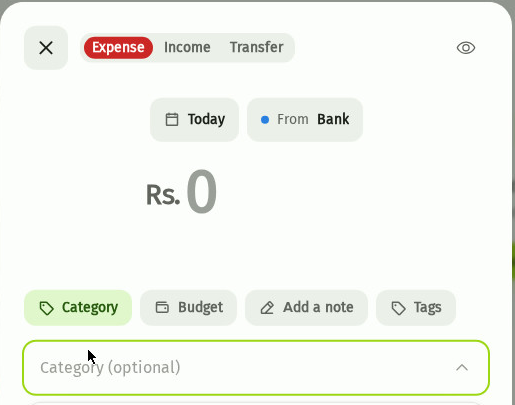
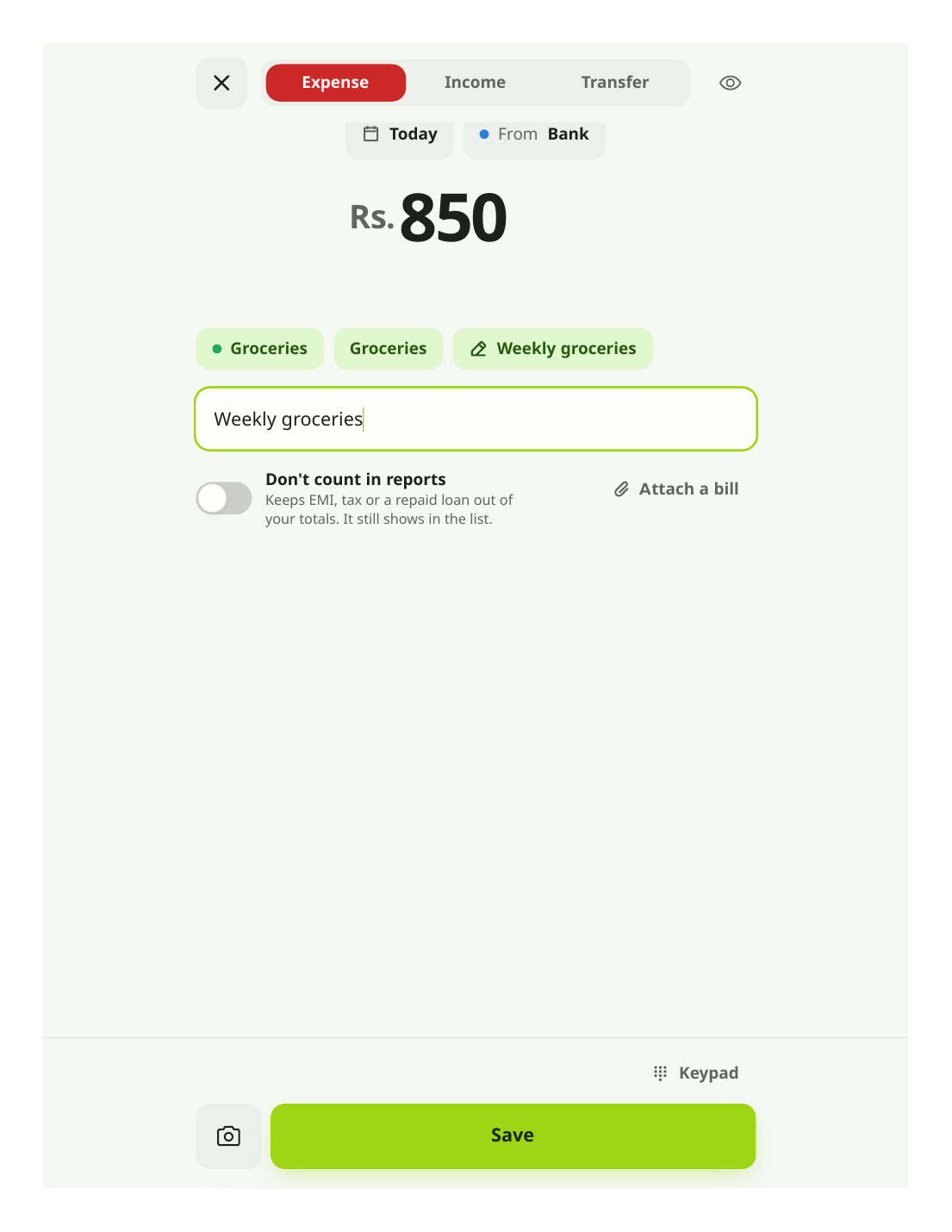
Manual entry in Lipi will feel familiar if Wallet trained you. Pick expense, income or transfer, type the amount, choose the category and the account it came from, save. The entry screen also carries a camera for scanning a paper bill. There is no feed to check, no re-authorisation to renew, and no aggregator in the middle. An entry you typed is an entry that stays typed.
What broken sync really costs
A budget app fails in two ways. It fails loudly, with an error you fix the same day, or quietly, and you find out at the end of the month when the numbers do not add up. The Wallet reviews mined for this page describe the quiet kind far more often.
A feed that changes an account from euros to Swiss francs and leaves 481 entries to retype is a loud failure with a quiet cause: the owner trusted the sync and stopped checking. A feed that skips 8 or 9 days of card spending each month is quiet from the start, because the missing days look exactly like days you spent nothing.
Lipi trades that risk for a smaller, visible one. Typing each entry takes a few seconds, and a month of daily entries adds up to a real cost in time. The trade is honest about itself: every entry in the book is one you put there, so the book is never wrong in a way you cannot see. A wrong amount is a typo you can fix in seconds, not a feed rewriting hundreds of rows while you sleep.
If you track three or four transactions a day and you check the book weekly, manual entry holds up fine. If you run fifty card transactions a week across four accounts and you will not type them, no manual app will hold you, and this page will not pretend otherwise.
Categories and budgets that fit the household
Eleven categories is the number that keeps coming up in Wallet reviews. Categories are how a budget app answers the only question people ask it: where did the money go. Eleven buckets force a choice between lumping and splitting. Put loan payments, gold purchases and client income into "other" and the monthly review tells you nothing.
Lipi lets you add, edit and remove categories in the app, so the category list grows with the household instead of stopping at eleven. Give each regular bill, side income and loan its own category, and the review at month end reads the way the month actually went. Budgets sit on top of the same list: a monthly budget per category, and the free plan holds 3 active budgets. That covers food, transport and household, the three categories that usually decide a month. The salary budgeting guide works through a month on a fixed salary, budget by budget.
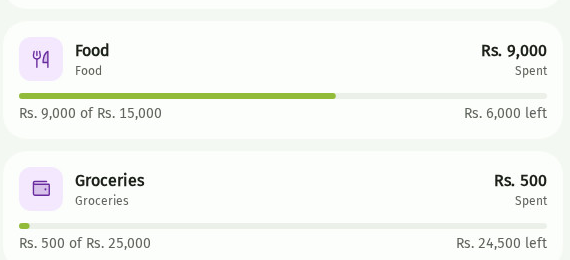
The budget gap in Wallet goes further than the count. The web app has no budget feature, so planning on a computer means switching to the phone. Lipi budgets live in the app, and the same account opens in a browser when you want a bigger screen.
One month, four kinds of money
Here is one month's money run through both apps. A household keeps a grocery budget of Rs 15,000, and splits a Rs 4,500 dinner three ways with a friend most weeks. One of them owns 1 tola of gold. A loan takes Rs 25,000 a month in EMI. A small freelance payment of USD 200 lands in a separate account.
In Wallet the grocery budget lives on the phone, the categories number eleven, and the dinner split has no home: a shared wallet holds the dinner or the groceries, and the friend who owes a third of the dinner is not a person in the wallet. The gold and the loan sit outside the app, the gold as a note and the loan as a recurring bill date. The USD 200 arrives through the feed or it does not.
In Lipi the same month fits in one place. The grocery budget is one of three free budgets. The dinner gets a split, Rs 1,500 each, waiting to be marked paid. The gold holding shows its live value next to the bank balance. The loan carries its EMI schedule, and a prepayment test shows what an extra Rs 50,000 would save before the money moves. The USD 200 sits in its own account in the same book, in dollars. The splits guide shows the settle flow, and the loans and EMI guide works a full prepayment example.
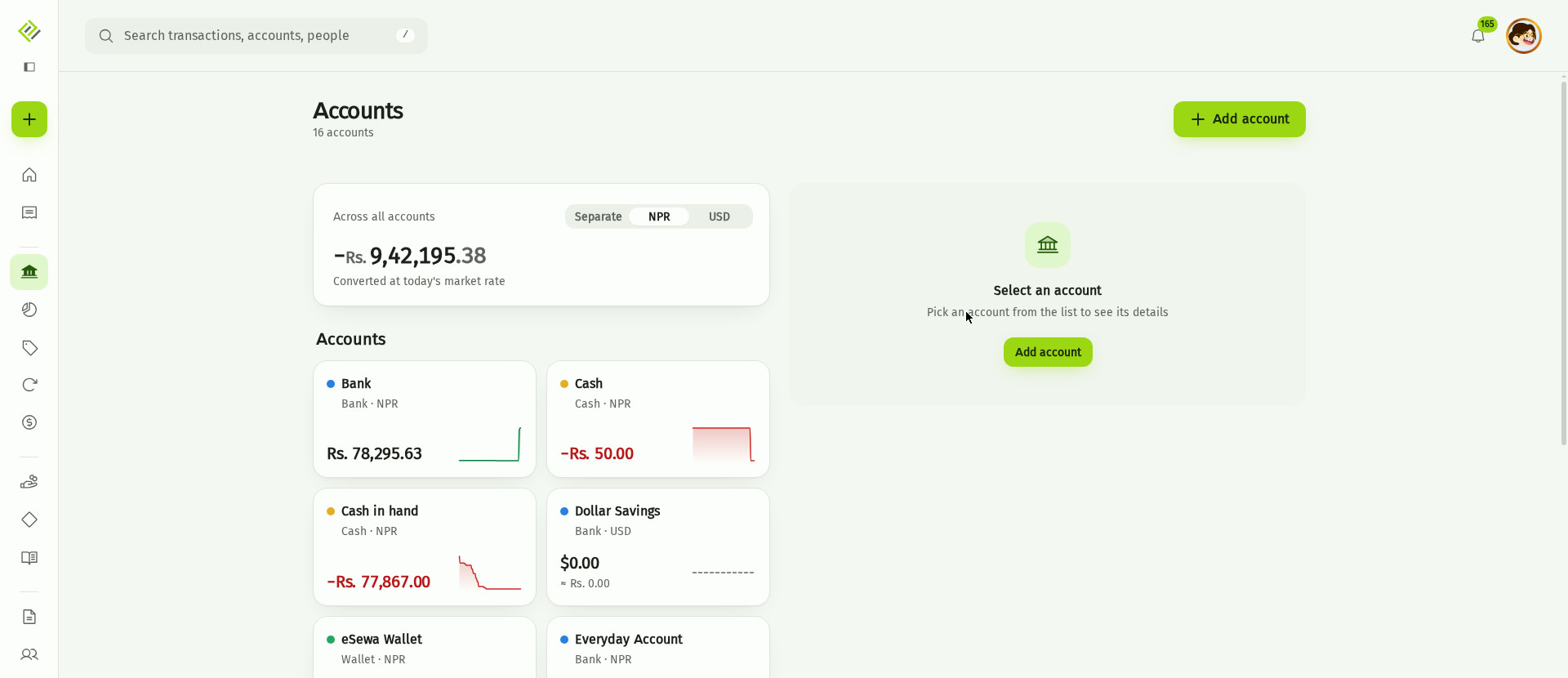
Wallet tracks the spending when its feed holds. Lipi tracks the household.
What each one costs
Wallet publishes no prices on its own site, so the figures below are the US App Store in-app purchase list, checked on 18 November 2026. The App Store lists four Premium prices with no period attached to any of them, so this page states no monthly Wallet price. Regional and store prices vary.
| Cost | Wallet by BudgetBakers | Lipi |
|---|---|---|
| Start | Free, manual tracking, limits not stated publicly | Free, 2 accounts and 3 active budgets |
| Bank sync | Premium, in-app purchases from $5.99 | No bank connection offered |
| Premium prices listed | $5.99, $14.99, $24.99 and $29.99, period not labelled | USD 3 a month, or USD 2 a month billed yearly (USD 24) |
| 3-year Premium | $49.99 | No 3-year option |
| Lifetime Premium | $29.99, one payment | No lifetime option |
| Five years, everything included | $29.99 lifetime, once | $120, at USD 24 a year |
| Sharing | Group sharing, on Premium | Shared accounts and splits, free |
Wallet's $29.99 lifetime is the cheaper deal over five years than five years of Lipi Premium at $120, and reviewers who bought it call it worth the money. The other one-time price in this comparison is Money Lover Premium at $19.99. If you plan to keep one app for years and you want the feed, the lifetime price is genuinely good value. Lipi's free plan is the fuller one, so the switch pays off before any subscription enters the picture.
Third-party reviews quote monthly estimates around $3 to $6 a month and yearly figures around $23 to $45, and they disagree with each other. This page uses only the App Store listing figures above, because those are the prices a buyer actually sees.
Where Wallet is still the better pick
Wallet earns its place. Its bank sync covers thousands of banks when it works, which no manual app can match for volume. It handles 150+ currencies with live rates. The $29.99 lifetime option is a real one-time price in a market of subscriptions, and reviewers praise it by name. It runs on iOS, Android, Mac and the web. Wallet Premium also includes stock tracking, which Lipi does not do at all: Lipi has no shares, no holdings and no portfolio view.
The switch makes sense for a narrower reader. You track by hand and want to keep it that way. The sync failures in the reviews read like your own experience. Eleven categories and a free tier with unstated limits are the friction you actually feel. And at least one item in the wider book (a second currency account, gold, a loan schedule, a split between friends, client invoices) is a side record you are tired of keeping elsewhere.
If automatic import is the feature you will not give up, Wallet Premium is the better pick, and Lipi will not match it because Lipi has no automatic bank feed at all.
Moving your history across
Wallet exports transactions as CSV and XLS, but only from the web app, not from the phone, and budgets, savings goals, recurring payment schedules and custom settings do not export at all. So a move across means the transactions can travel and the setup cannot.
In Lipi, bringing records in works two ways. Statement import takes a bank statement file and turns it into entries, and it is a Premium feature. Or you start the Lipi book on a clean date with opening balances that match your Wallet totals, keep the old app installed as the archive, and log forward. For a manual tracker, the clean start is often the calmer move, because years of categories rarely map one to one.
One honest limit on the Lipi side: data export (Backup JSON and Transactions CSV) is Premium-only, so the free plan does not export.
Run Lipi beside Wallet for two weeks of real spending, then compare totals on the same day in both apps. The one you still open without being reminded is your answer.
Questions people ask before switching
Is Lipi free?
Yes, to start and to keep using for daily tracking. Manual entry, 2 accounts, 3 active budgets, custom categories, shared accounts, splits and invoices are free. Premium, at USD 3 a month, or USD 2 a month billed yearly (USD 24), unlocks more accounts, assets and gold history, loans, statement import and data export.
Is Wallet by BudgetBakers free?
Yes, with limits. The free tier covers manual tracking, and BudgetBakers states nothing public about exactly where it stops. Bank sync, unlimited accounts, reports, stock tracking, flexible budgeting and group sharing need Premium. The US App Store lists Premium at $5.99, $14.99, $24.99 and $29.99 with no period labelled, plus 3-Year Premium at $49.99 (checked 18 November 2026) and Lifetime Premium at $29.99 (re-verified 21 November 2026).
Does Lipi connect to my bank?
No. Lipi never asks for bank credentials and has no automatic bank feed. Entries are typed by you, or posted from bank SMS on your phone through Auto Sync. If automatic import is the feature you will not give up, Wallet Premium is the better pick, and this page says so in the section above.
Does Lipi track gold and loans?
Yes. Gold is recorded by weight in tola, lal or gram and valued at the live price, with the 30-day chart and price history in Premium. Loans carry an EMI schedule with prepayment options, also in Premium, and the free loan calculator lets you test a prepayment first. The gold tracking guide walks through the units before you record anything.
What does Premium cost, exactly?
USD 3 a month, or USD 2 a month billed yearly (USD 24). One price for the whole book, no separate sync subscription, and no per-platform purchase to repeat when you change phones.
The short version
Lipi is the free alternative to Wallet by BudgetBakers for manual tracking. Everything above is about whether the wider book earns the switch for you.
Open Lipi if the wider book sounds like your side records. Your first week costs nothing, and the book you build holds the shared budget, the gold and the loan alongside the spending.
Sources
- Lipi guides linked in this page: Split expenses with friends, EMI prepayment, Gold tracking, Budget on a salary.
- Wallet facts were checked against the Wallet listing on Google Play, the Wallet listing and in-app purchase list on the US App Store, and BudgetBakers' own site, on 18 November 2026. Review quotes are from Trustpilot, Google Play and the App Store, mined 18 November 2026.
Sources
- How to split expenses with friends in Lipi, Lipi (read 18 November 2026)
- Loans and EMI in Lipi: track the schedule, prepay, and move the payoff date, Lipi (read 18 November 2026)
- Track your gold in Lipi: tola, grams and ounces, with bought-at price and live value, Lipi (read 18 November 2026)
- How to budget on a salary in Lipi, Lipi (read 18 November 2026)
Keep reading
Guide
Free alternative to Money Lover: Lipi for budgets that span every account
Lipi is the free alternative to Money Lover for budgets that span every account: per-category budgets across cash and card, shared accounts and splits free, multi-currency accounts, gold, loans and invoices in one book. Premium costs USD 3 a month, or USD 2 a month billed yearly (USD 24).
16 min read
Guide
Free alternative to Spendee: Lipi for shared budgets and manual tracking
Lipi is the free alternative to Spendee for shared budgets and manual tracking: shared accounts and splits without a paid tier, multi-currency accounts, gold, loans and invoices in one book. Premium costs USD 3 a month, or USD 2 a month billed yearly (USD 24).
15 min read2 views
Guide
Free alternative to YNAB: Lipi for budgeting without the subscription
Lipi is the free alternative to YNAB for people who want to budget without a $109 a year subscription: monthly category budgets, manual offline entry, multi-currency accounts, gold, loans and splits. Premium costs USD 3 a month, or USD 2 a month billed yearly (USD 24).
17 min read1 view
Guide
Spendee vs Lipi: which tracker wins for shared budgets and manual tracking?
Spendee vs Lipi for shared budgets and manual tracking: Lipi wins. Sharing and splits are free in Lipi where Spendee puts them behind Plus, and the wider book holds gold, loans and invoices in the same place. Premium costs USD 3 a month, or USD 2 a month billed yearly (USD 24).
17 min read1 view