Guide
Free alternative to YNAB: Lipi for budgeting without the subscription
Lipi is the free alternative to YNAB for people who want to budget without a $109 a year subscription: monthly category budgets, manual offline entry, multi-currency accounts, gold, loans and splits. Premium costs USD 3 a month, or USD 2 a month billed yearly (USD 24).
By Bikram LamaPublished Updated 17 min read1 view
Lipi is a free alternative to YNAB, with budgeting that costs nothing to start.
You set monthly budgets by category, log each expense by hand, and watch the month fill up. No subscription stands between you and the budget, and no bank login is asked for. What changes, next to YNAB, is the price and the shape of the book around the budget. A year of YNAB costs $109, against $24 for a whole year of Lipi Premium billed yearly, and the same book also holds a second currency, a gold holding, a loan schedule and a shared bill.
Open Lipi and set your first monthly budget today. It costs nothing to start, and the entries feel like the ones you already type.
Why people go looking for a YNAB alternative
YNAB is a good app with a method people swear by, and most of its reviews say so. The low ratings repeat a short list of complaints, and the list is worth reading before you decide whether any alternative, Lipi included, actually answers yours.
The loudest complaint is the price. YNAB costs $14.99 a month or $109 a year, with a 34 day trial and no free plan after it. A four star App Store review from September 2026 puts it plainly:
"I really like YNAB but I think it's too expensive."
That is a reviewer who likes the app. The price still pushed them to write. A Trustpilot review from October 2025 says the same thing from a different angle:
"Love it but too pricey. No one around me wants to sign in because of this. Also, I have bad connection with my bank and always have to reautorize."
The second complaint is about the bank import that the subscription pays for. A one star App Store review from October 2026 reads:
"This app used to be great for tracking spending and making a budget but it now takes 12-24 hours to sync transactions."
A Google Play review from February 2026 paid for the same promise and got the same result:
"paid for the subscription so I could link my accounts automatically, but they rarely / never work. Im constantly resetting them or adding transactions manually. I want to like it but overall its very frustrating. I reached out via the live chat and the customer service rep said I'd just have to enter my bank transactions manually."
The same reviewer, in the same review, weighed the price against what the app holds:
"solid foundation for a budget app, accounting for each dollar every month. but it struggles with credit cards, and I wish there were more analytics like for spending trends, maybe visuals of income vs spending, maybe a breakdown of budgeted funds. the features are a little sparse as is, for the over $100 price tag. I'll be debating whether to renew this year."
A third complaint is the learning curve. YNAB asks you to give every dollar a job before you spend it, and to keep doing it every week. One App Store reviewer in a study of 1,586 one and two star reviews put the feeling in one sentence:
"It overwhelmed me by giving me another 'job' to do. I needed to reduce my cognitive load, not add to it."
That study coded 200 of YNAB's most recent critical App Store reviews. Redesigns were 48 percent of them, sync 14 percent, missing features 13 percent. A separate analysis of low star reviews across the five biggest budgeting apps found bank sync failures in 34 percent of negative reviews and price shock in 22 percent. YNAB's own price history feeds the second number: the annual price rose from $84 to $99 to $109 over three years, and each rise brought a wave of one star reviews from long time users.
Lipi answers the first three directly. Budgeting starts free, with 3 active budgets on the free plan. Entry is manual, so a transaction is in your budget the second you type it, with no import to wait for and no connection to drop. And a monthly category budget asks for one decision per category per month, not a weekly ritual of assigning every dollar.
One mined complaint gets no promise from this page. YNAB's 2026 redesign hid numbers behind progress bars, and reviewers miss the old detail. Lipi makes no claim about matching YNAB's reporting depth. If detailed budget reports are the feature you shop for, test both apps with one month of real spending before you move.
YNAB and Lipi, side by side
Both apps are built around a budget, and both will show you where the month went. The differences sit in what the budget costs, how the money gets in, and what else the book holds. YNAB facts are from YNAB's own pricing page, checked on 17 November 2026. For the head-to-head, YNAB vs Lipi compares the two on budgeting without the subscription.
| Feature | YNAB | Lipi |
|---|---|---|
| Budgeting method | Give every dollar a job before you spend it, with targets and a loan planner | Monthly budgets by category, 3 active on the free plan |
| Price | $14.99 a month or $109 a year, plus tax where applicable | Free to start; Premium USD 3 a month, or USD 2 a month billed yearly (USD 24) |
| Free plan | None after the 34 day trial | Yes, daily tracking, splits and invoices included |
| Trial | 34 days, no card when you sign up directly | No trial needed, the free plan has no end date |
| How transactions get in | Import from linked banks, or manual entry if you prefer | Manual entry, typed by you, with a scan option on the entry screen |
| Working offline | Yes, with updates across devices | Yes, entries sync to your account when you are back online |
| More than one currency | One currency per spending plan, in YNAB's own words | Yes, accounts in different currencies in one book |
| Budgets per plan | One plan, unlimited categories | 3 active budgets free, more in Premium |
| Loans | Loan planner and debt management, in the subscription | A loan book with an EMI schedule and prepayment that moves the payoff date |
| Gold | Nothing on the pricing page | Weight in tola, lal or gram, with a live value |
| Splitting a bill | Nothing on the pricing page | Yes, free, one bill per split |
| Invoices and clients | Nothing on the pricing page | Yes, free |
| Sharing | One subscription covers up to six people | Shared accounts in the same book |
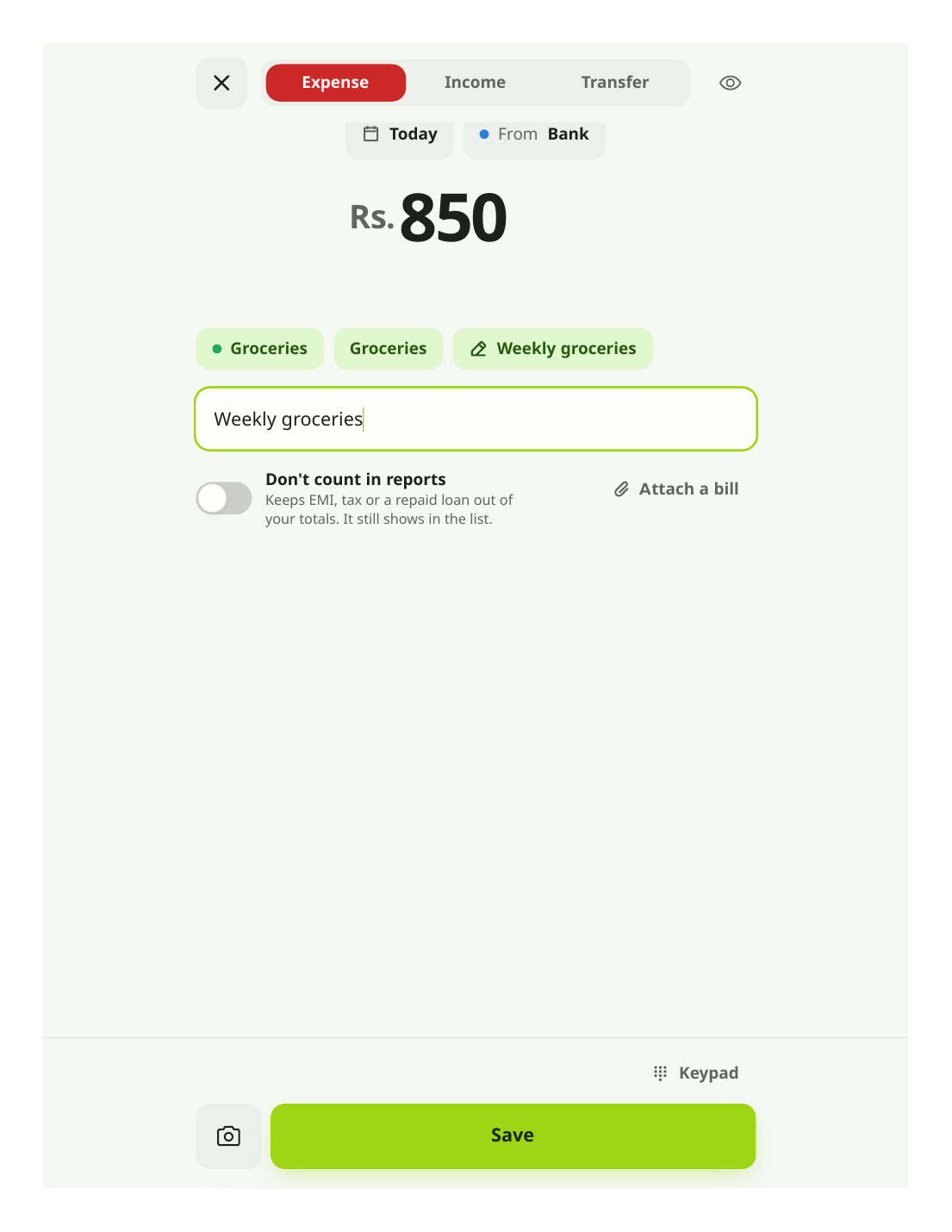
Manual entry in Lipi is the whole point of the switch for a YNAB leaver who was told to enter transactions by hand anyway. Pick expense, income or transfer, type the amount, choose the category and the account it came from, save. The entry screen also carries a camera, so a paper bill can be scanned or attached instead of described from memory later. A budget in Lipi is a monthly limit per category, and the month fills up as you log. It will not teach you YNAB's method, and it does not try to.
What a month of YNAB actually costs
Prices for YNAB are from ynab.com/pricing, checked on 17 November 2026. Lipi prices are the standing Premium prices for this comparison. All figures are in US dollars, before tax.
| Cost | YNAB | Lipi |
|---|---|---|
| One month | $14.99 | Free, or $3 on Premium |
| One year, annual billing | $109 | Premium for a year: $24 |
| One year, monthly billing | 12 x $14.99 = $179.88 | Premium for a year: $36 |
| Five years, annual billing | 5 x $109 = $545 | Premium for five years: $120 |
| Five years, monthly billing | 60 x $14.99 = $899.40 | Premium for five years: $180 |
Read the table slowly, because the wedge is the argument of this page. Two months of YNAB at $14.99 cost more than a full year of Lipi Premium at $24. One year of YNAB at $109 buys about four and a half years of Lipi Premium. Over five years the gap is $425 on annual billing and $719.40 on monthly billing. YNAB's own page says the annual plan saves $70 against monthly billing. The arithmetic agrees, near enough: $179.88 minus $109 is $70.88.
Two honest readings of that table. YNAB's price buys the method, the teaching and the support, and one subscription covers up to six people, which softens the arithmetic a lot if you have a household to share it with. At about $18 a person a year across six people, the method costs less than a takeaway lunch each. And Lipi Premium at $3 a month is a price for the wider book, not a price for a budgeting method, so the comparison is only fair if the method is not what you are buying.
If you are still weighing an app against a spreadsheet rather than against YNAB, the expense tracker vs spreadsheet comparison runs that test honestly.
What the wider book does to a monthly budget
A budget answers one question well: how much is left in each category. The money around the budget usually lives somewhere else, in a notes app, a spreadsheet, or your head. Lipi puts four kinds of it in the same book, and each one removes a side record.
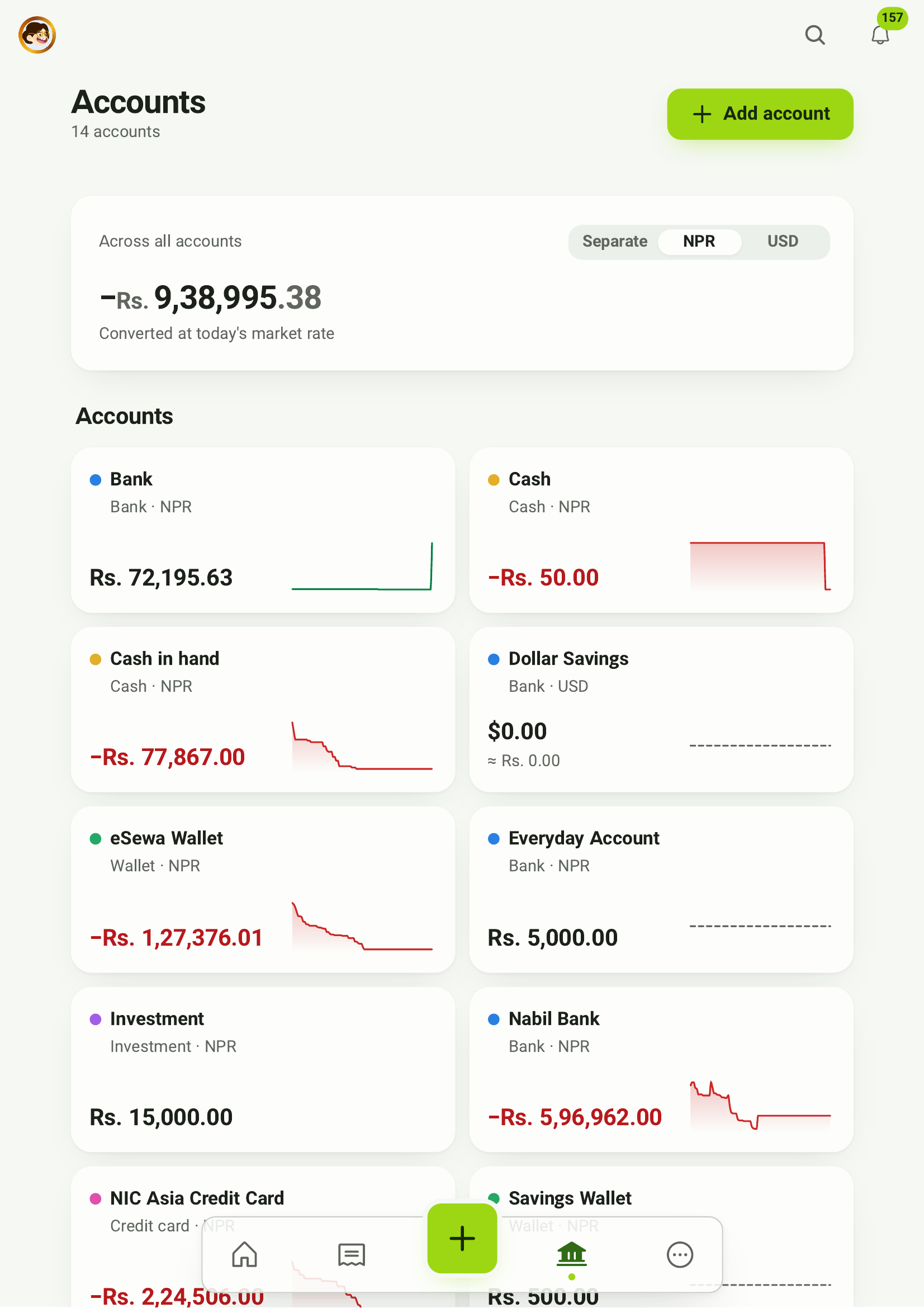
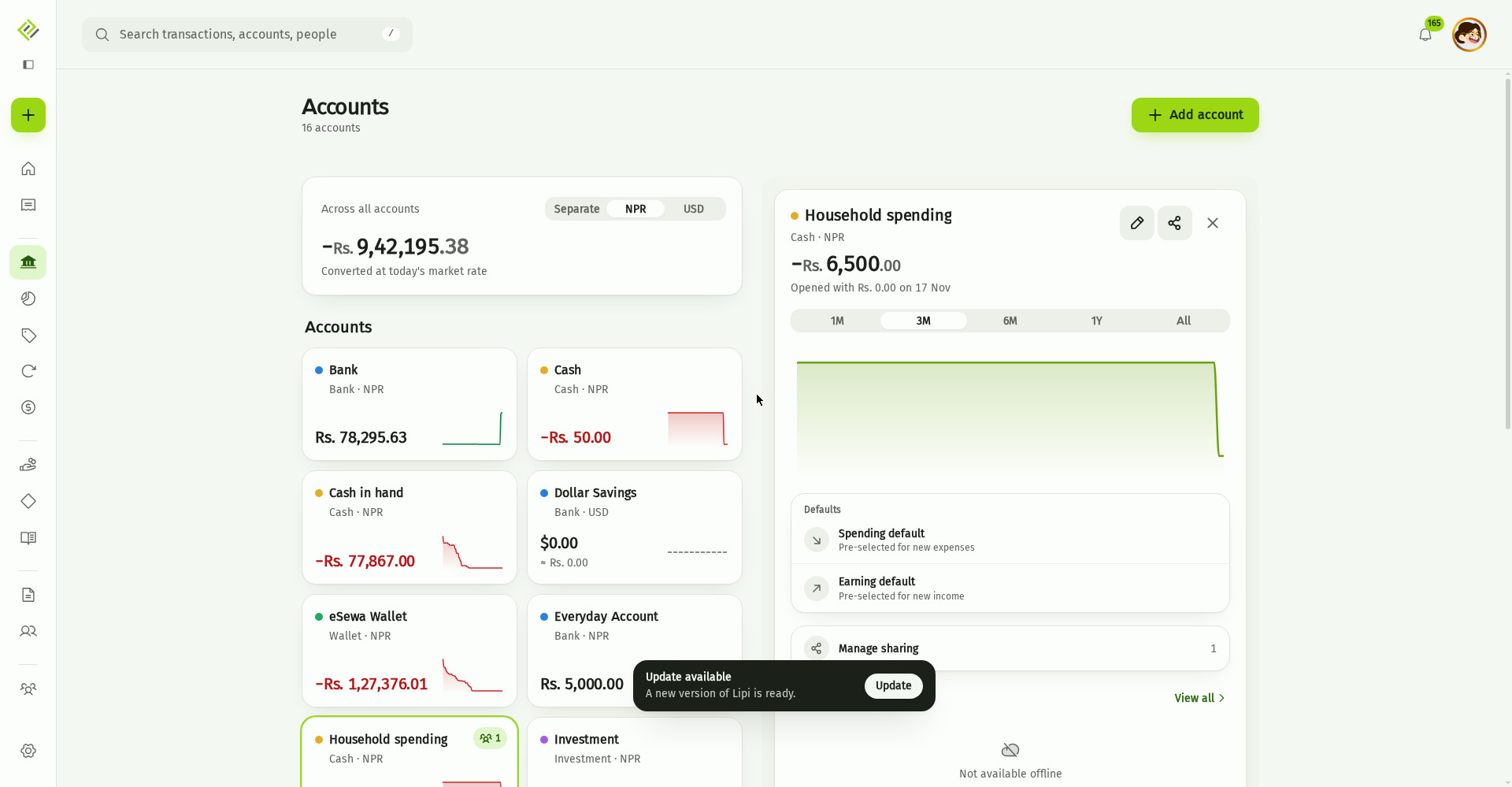
Accounts in different currencies stop being separate books. YNAB's own pricing page says you can pick a currency for a plan but you cannot use multiple currencies together in one spending plan. In Lipi a salary account, cash, a wallet and a card sit in one list, each in its own currency, and transfers move money between them without pretending a transfer was spending. People who earn in one currency and spend day to day in another feel this first, because a single currency budget is where their totals start to drift.
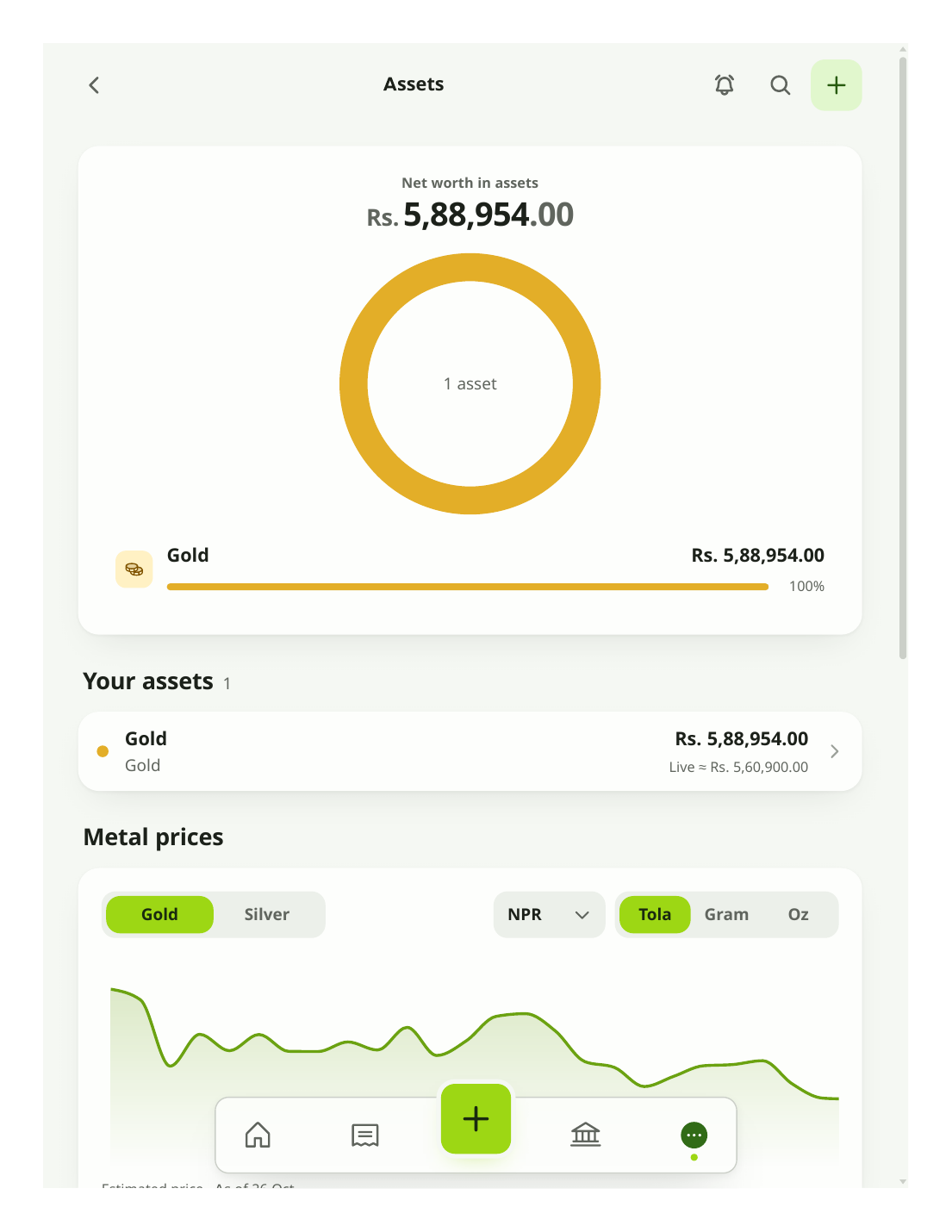
Gold gets a holding rather than a note. You record the weight in tola, lal or gram and, if you want, the price you paid per tola. The app follows the live value from there. Following your own gold in detail, with its 30 day chart and price history, sits in Premium, and the gold tracking guide walks through the units before you record anything.
A loan gets its schedule instead of a reminder. The EMI lands on its dates, and a prepayment shows you the choice: lower EMI, or a shorter tenure, with the interest saved stated before you commit. The loans and EMI guide works a full example. Loans are a Premium feature in Lipi, and the free loan calculator still lets you test a prepayment before you pay for anything. YNAB's loan planner is real too, and it is part of the subscription. The difference is that Lipi's loan book lives beside the budget it affects, so the EMI and the spending sit in one month.
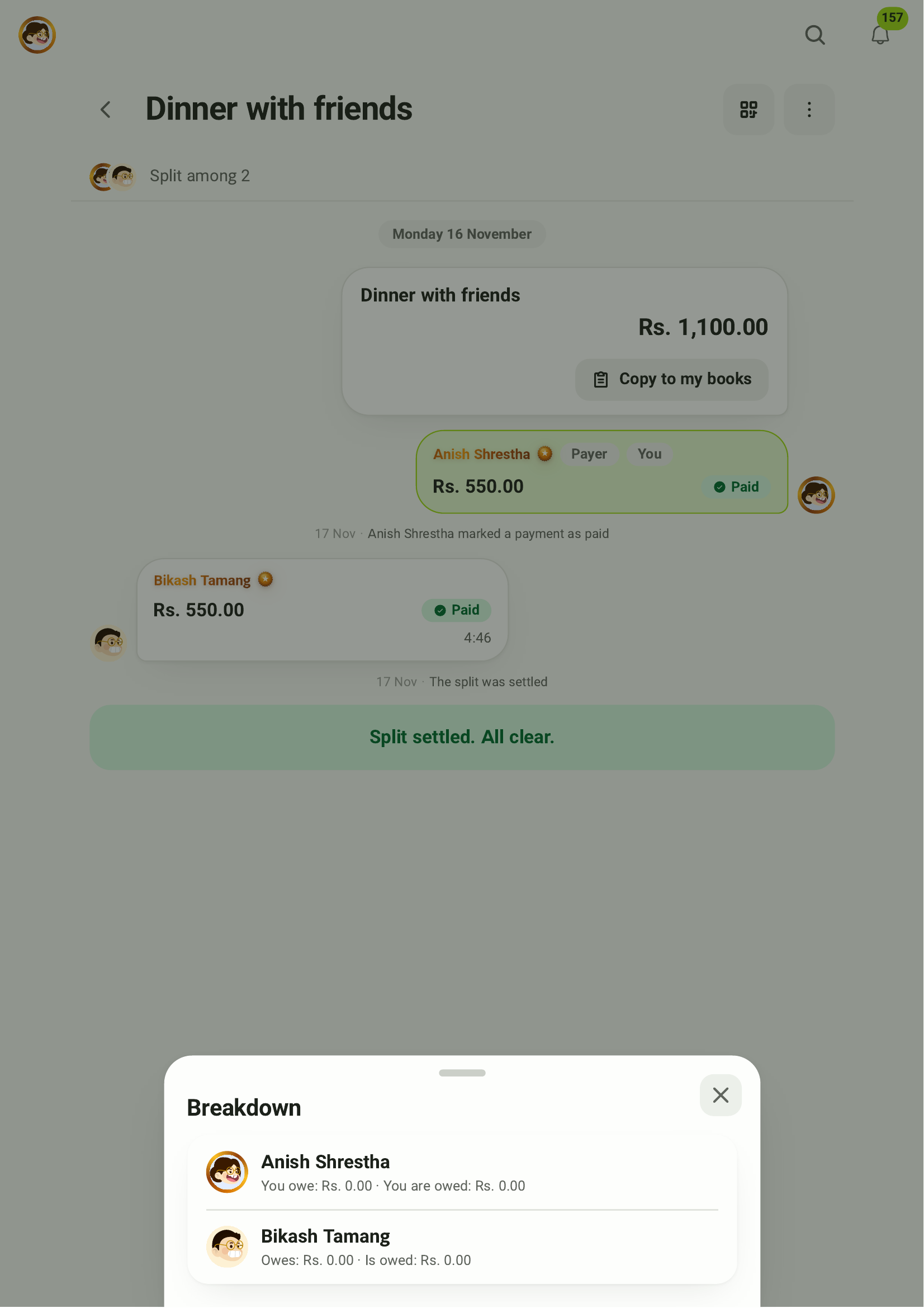
Shared spending gets a split. One bill, the people on it, equal or custom shares, and a breakdown of who owes whom until everyone has marked paid. Splits cost nothing in Lipi. YNAB Together shares one subscription across up to six people, which is the stronger household answer if everyone in the house budgets. Lipi's answer is narrower and cheaper: shared accounts for the household book, and splits for the money owed between people. The splits guide shows the settle flow, and the monthly money routine shows where splits and budgets meet at the end of a month.
One person, one month, both apps
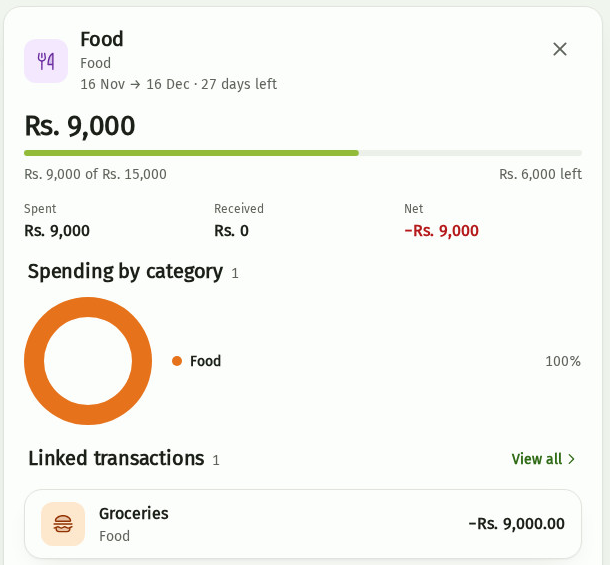
Tables flatten real life, so here is one month of money run through both apps. She earns in one currency and spends day to day in another. She owns 2 tola of gold. A loan takes Rs 45,000 a month in EMI, and she splits a Rs 2,500 dinner with a friend most weeks. Groceries run about Rs 850 a week, the amount in the entry screenshot above.
In YNAB she plans the spending in one currency, tracks the loan balance, and the second currency, the gold and the dinner split sit outside the budget. The groceries go in by hand when the import lags, which is the exact chore the subscription was meant to remove. In Lipi all of it sits in one place: both currency accounts, a Food budget that fills up Rs 850 at a time, the gold holding valued at today's price, the EMI schedule with its payoff date, and the dinner split waiting to be marked paid. That is the whole argument of this page in one example. YNAB plans a budget. Lipi holds the month around it.
Where YNAB is still the better pick
YNAB teaches a method, giving every dollar a job before it is spent, and people who take to the method tend to stay for years. The teaching material is the best in its class, one subscription covers up to six people, and the 34 day trial needs no card when you sign up directly. Lipi does not teach a method. Lipi's budgets are monthly category budgets, a limit per category that fills up as you log. If the method itself is what you want, if you want to be told what to do with each dollar and to learn a system that changes how you think about money, stay with YNAB and pay the $109. No alternative on this page, Lipi included, replaces a teacher.
The switch makes sense for a narrower reader. You tried the method and it felt like a second job, or the price is the part that stings, or you were entering transactions by hand anyway while paying for an import that lagged a day behind. You want a budget that costs nothing to start, accounts in more than one currency, and a book that also holds gold, a loan and shared bills. That reader should try Lipi first and keep YNAB installed until the trial month is done.
Moving your history across
YNAB exports a budget, so your history can leave with you. In Lipi, bringing records in works two ways. Statement import takes a bank statement file and turns it into entries, and it is a Premium feature. Or you start the Lipi book on a clean date with opening balances that match your YNAB totals, keep the old app installed as the archive, and log forward. For a budgeter, the clean start is often the calmer move, because a YNAB plan built on giving every dollar a job rarely maps one to one onto monthly category budgets.
Give the new book a fair trial either way. Run Lipi beside YNAB for one full month of real spending, then compare totals on the same day in both apps. The one you still open without being reminded is your answer. If YNAB's method is what kept you opening it, that comparison will tell you so, and the $109 will have earned its keep.
Questions people ask before switching
Is YNAB free?
No. YNAB costs $14.99 a month or $109 a year, after a 34 day free trial that needs no card when you sign up directly. There is no free plan once the trial ends. College students get a free 365 day trial with proof of enrolment.
Is there a free alternative to YNAB?
Yes. Lipi budgets for free, with manual entry, monthly category budgets, splits and invoices on the free plan. Actual Budget and EveryDollar also offer free routes to the same zero based method, but they need setup or carry their own limits, and neither holds gold, loans or splits in the same book. If the method itself is what you want for free, Actual Budget is the closer match, and this page says so plainly.
What is the best free YNAB alternative?
It depends on why you are leaving. If the method is what you want, Actual Budget copies it for free. If the price and the import are what pushed you out, and you want a budget that also holds a second currency, gold, a loan and shared bills, Lipi is the free alternative this page argues for. If you only want to log spending and nothing more, a free manual tracker does that job for nothing.
Does Lipi work offline?
Yes. Entries are recorded on the device with no connection and sync to your account when you are back online. A flight or a shop with no signal leaves the habit untouched.
Does Lipi teach YNAB's method?
No. Lipi sets monthly budgets by category and tracks what you spend against them. It does not assign every dollar a job in advance, and it does not teach the four rules. Readers who want the method should stay with YNAB, or take the free route through Actual Budget.
Can I budget in two currencies in Lipi?
Yes. Accounts hold their own currencies inside one book, and transfers between them record the move without counting it as spending. YNAB's own pricing page says a single spending plan runs in one currency, so this was one of the mined questions for this page, and it is the case where a single currency budget strains first.
What does Premium cost, exactly?
USD 3 a month, or USD 2 a month billed yearly (USD 24). One price for the whole book, no separate sync subscription, no second app to install, and no per person charge to repeat when a second person joins the household book.
The short version
Lipi is a free alternative to YNAB for budgeting without the subscription, and that sentence is the whole pitch. A year of YNAB costs $109 against $24 for Lipi Premium billed yearly, the budget starts free, and the book around it holds a second currency, gold, a loan and shared bills. Everything after that sentence is about whether the method is what you are buying, because if it is, YNAB is still the app to pay for.
Comparing other apps too? Lipi as a free alternative to Money Manager and a free alternative to Spendee covers the same switch from different starting points, and the best expense tracker apps round-up puts all three side by side.
Open Lipi if the price, the import or the weekly ritual is what pushed you out. Your first month costs nothing, the entries feel like the ones you already type, and the book you build holds the loan, the gold and the shared bills alongside the budget.
Sources
- Lipi editorial standards, Lipi (read 17 November 2026)
Keep reading
Guide
Free alternative to Money Lover: Lipi for budgets that span every account
Lipi is the free alternative to Money Lover for budgets that span every account: per-category budgets across cash and card, shared accounts and splits free, multi-currency accounts, gold, loans and invoices in one book. Premium costs USD 3 a month, or USD 2 a month billed yearly (USD 24).
16 min read
Guide
Free alternative to Wallet by BudgetBakers: Lipi for manual tracking
Lipi is the free alternative to Wallet by BudgetBakers for manual tracking: entries typed by hand with no bank login to break, 2 accounts and 3 budgets free, custom categories, multi-currency accounts, gold and loans in one book. Premium costs USD 3 a month, or USD 2 a month billed yearly (USD 24).
16 min read1 view
Guide
Free alternative to Spendee: Lipi for shared budgets and manual tracking
Lipi is the free alternative to Spendee for shared budgets and manual tracking: shared accounts and splits without a paid tier, multi-currency accounts, gold, loans and invoices in one book. Premium costs USD 3 a month, or USD 2 a month billed yearly (USD 24).
15 min read2 views
Guide
Spendee vs Lipi: which tracker wins for shared budgets and manual tracking?
Spendee vs Lipi for shared budgets and manual tracking: Lipi wins. Sharing and splits are free in Lipi where Spendee puts them behind Plus, and the wider book holds gold, loans and invoices in the same place. Premium costs USD 3 a month, or USD 2 a month billed yearly (USD 24).
17 min read1 view